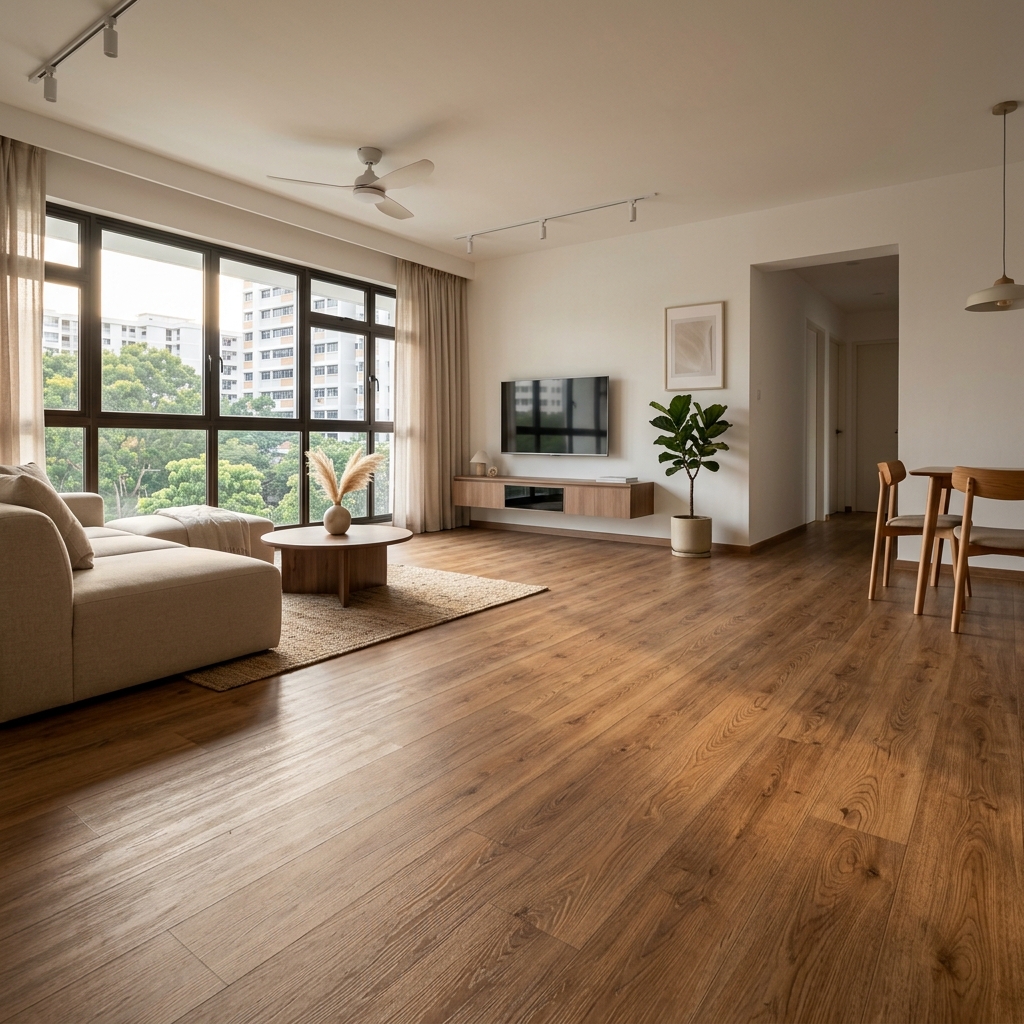
For Singapore HDB flats in 2026, vinyl flooring (LVT or SPC) is the recommended choice — 100% waterproof, humidity-resistant, overlay-compatible, and cost-efficient. Laminate is generally unsuitable for Singapore's climate, and tiles, while durable, come with high upfront hacking costs. Here's the full breakdown.
Why Singapore's Climate Changes Everything
Singapore sits at 1°N — year-round heat, 70–90% average humidity, and regular temperature swings between air-conditioned interiors and outdoor air. These conditions eliminate many flooring options that work perfectly in temperate climates.
The core problem is moisture and expansion. Any flooring with an organic core — real timber, wood-fibre laminate — will absorb ambient humidity and expand over time. In Singapore, this isn't a seasonal problem. It's a constant daily stress on your floor.
This is why waterproofing isn't a luxury feature for Singapore flooring — it's a baseline requirement.
Compare all flooring options by what matters most in Singapore:
Best for: Bedrooms, living rooms, study rooms. Overlay-compatible — no hacking required.
Best for: Corridors, living rooms, commercial. Superior stability for non-aircon rooms.
Avoid in Singapore. HDF core absorbs humidity and swells within 1–3 years in non-aircon conditions.
Best for kitchens & bathrooms only. Hacking adds S$2,000–$4,000 to renovation cost for dry rooms.
Vinyl Flooring (LVT) — The Recommended Choice for Most HDB Rooms
LVT stands for Luxury Vinyl Tile (or Plank). It has a fully synthetic PVC construction — no wood fibre, no organic content — which means it does not absorb moisture and will not warp, swell, or buckle in Singapore's humidity.
Specs to Look For
- Thickness: 5mm (economy), 6mm (standard residential), 7mm (premium)
- Wear layer: 0.3mm for bedrooms, 0.5mm for high-traffic living areas
- Waterproof rating: Full core waterproof (not just surface-treated)
- Click-lock vs glue-down: Click-lock is faster to install and easier to replace
Where LVT Works Best in an HDB
- Living rooms and dining areas
- Bedrooms (warmer and quieter than tiles)
- Study rooms
- Overlay over existing HDB tiles (no hacking needed)
Key advantage: LVT can be installed directly over your existing HDB tiles without hacking. This saves S$800–S$2,000 in demolition costs and avoids the noise, dust, and neighbour inconvenience of tile removal.
LVT — Layer Cross-Section
Korean SPC — Layer Cross-Section
Korean SPC Flooring — The Upgrade Option
SPC (Stone Plastic Composite) is a premium-grade vinyl with a rigid limestone core instead of a flexible PVC core. The critical difference: SPC is dimensionally stable. It expands and contracts far less with temperature and humidity changes.
LN Flooring imports Korean-manufactured SPC — known in the trade as the highest grade available — which carries tighter tolerances, cleaner click-lock joints, and longer wear layers (typically 0.5mm).
When to Choose SPC Over LVT
- High-foot-traffic areas (corridors, living rooms, commercial spaces)
- Singapore HDB flats without consistent air-conditioning
- Any area where maximum dimensional stability is needed
- Commercial renovations (offices, retail frontages, F&B spaces)
The tradeoff: SPC is slightly harder underfoot than LVT and costs 20–35% more. For bedrooms where softness and warmth matter, LVT is often the better call.
Laminate Flooring — Not Recommended for Singapore
We'll be direct: laminate flooring is a poor choice for most Singapore HDB rooms. Here's why.
Laminate has a high-density fibreboard (HDF) core — essentially compressed wood powder. HDF is highly hygroscopic: it absorbs ambient moisture. In Singapore's climate, this causes:
- Swelling at plank joints over 1–3 years
- Warping in non-airconditioned rooms
- Edge lifting where boards meet walls or door frames
- Mould if any water gets under the boards
Laminate may survive in fully air-conditioned bedrooms — but even there, the risk isn't worth it when vinyl delivers the same wood-look aesthetic with none of the moisture issues. We don't install laminate and we actively advise against it for Singapore homes.
Floor & Wall Tiles — Durable but Expensive to Change
Porcelain and ceramic tiles are the original Singapore flooring solution — cool underfoot, extremely durable, and impervious to moisture. In 2026, they remain the best choice for kitchens and bathrooms.
Tile Pros
- Completely waterproof and mould-resistant
- Lifespan of 20–30+ years when properly grouted
- Available in marble-look, cement, mosaic, and large-format slabs
- Stays cool in Singapore's heat — preferred for living rooms in some homes
Tile Considerations
- Tile hacking is loud, dusty, and disruptive — advance notice to neighbours is essential
- Hacking and replacement significantly increases renovation cost (typically adds S$2,000–S$4,000)
- Cold and hard underfoot — not ideal for bedrooms
- Grout lines require periodic resealing
Room-by-Room Recommendation
| Room | Best Choice | Why |
|---|---|---|
| Living Room | Vinyl LVT or SPC | Durable, comfortable, overlay-compatible over existing tiles |
| Bedroom | Vinyl LVT (6mm) | Warm, quiet underfoot, moisture resistant, easier to maintain |
| Study / Home Office | Vinyl LVT | Comfortable for long hours, easy to clean, no hacking needed |
| Kitchen | Tiles | Heavy use, oil splashes, cleaning chemicals — tiles outlast vinyl here |
| Bathroom | Tiles | Direct water contact and waterproofing requirements — tiles are the right call |
| Corridor / Entrance | SPC | High foot traffic and direct sunlight exposure — SPC's rigid core handles this best |
| Commercial Space | Korean SPC | Maximum durability, dimensionally stable, easy to replace individual planks |
A Note on Wear Layers
The wear layer is the transparent protective coating on top of vinyl flooring. Thicker = more scratch and scuff resistance.
When comparing quotes from different contractors, always ask for the wear layer specification. A lower price often means a thinner wear layer — a difference that matters enormously in 3–5 years.
LN Flooring recommendation for 2026: For a full HDB flat renovation, the optimal combination is Korean SPC (6mm, 0.5mm wear layer) for living rooms and corridors, and LVT (6mm, 0.3mm wear layer) for bedrooms. Maintain existing tiles in kitchen and bathroom unless a full tile replacement is planned.