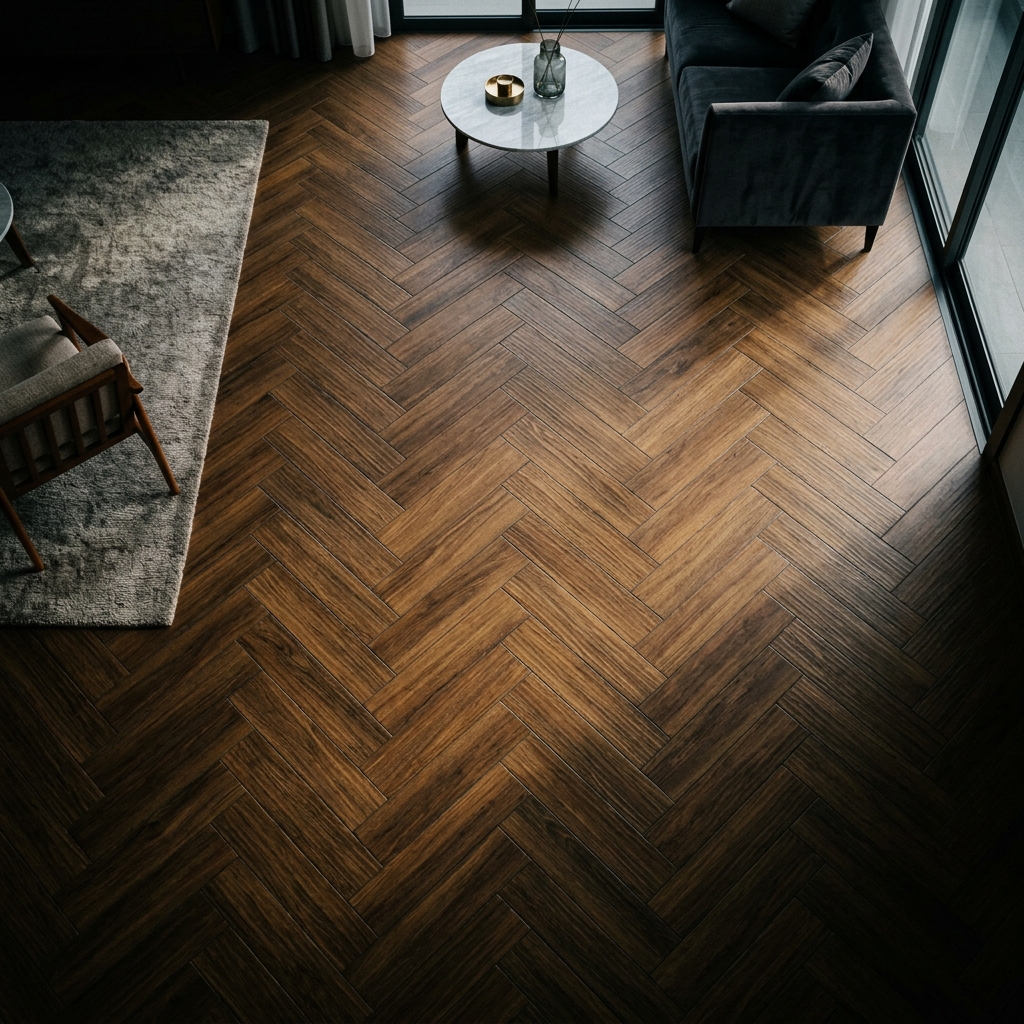
Herringbone vinyl flooring costs 20–35% more than standard plank installation — and in the right space, it is absolutely worth it. After 80+ herringbone installations across Singapore HDB flats and condos, the pattern consistently delivers the single biggest visual upgrade per dollar of any flooring decision. Here is the full breakdown: what it costs, where it works, and what to look out for before you commit.
What Is Herringbone Flooring?
Herringbone is a layout pattern, not a material. The same vinyl planks used in standard straight-lay installations are cut and arranged in an interlocking zigzag pattern — each plank set perpendicular to the two planks beside it, creating a continuous V-shape that reads as dynamic movement across the floor.
The name comes from a herring fish skeleton: the central "spine" of the pattern with angled "bones" branching outward. It has been used in Parisian apartments, English country houses, and Italian palazzos for centuries. In 2026, it is having a significant moment in Singapore residential design — particularly in condos and private estates, and increasingly in HDB premium renovation projects.
Herringbone vs Chevron: What Is the Difference?
Herringbone (90°)
Planks meet at right angles. Standard rectangular planks — no special cuts required. Lower waste, lower cost.
Chevron (45° cut ends)
Points meet precisely for a continuous arrow. Planks need angled end cuts. Higher precision, higher cost.
In Singapore, herringbone is installed far more commonly than chevron because it uses standard planks without special end cuts, reducing waste and labour cost. Chevron requires purpose-cut planks and higher-precision alignment — the premium over herringbone is typically 15–25% more.
How Much Does Herringbone Vinyl Flooring Cost in Singapore?
Herringbone installation costs 20–35% more than straight-lay installation of the same material. The premium covers three things: additional cutting time (every alternate plank requires precise right-angle cuts), material wastage of 8–12% (compared to 5–7% for straight lay), and the slower pace of laying a pattern versus running planks in a single direction.
| Space | Approx. Area | Straight Lay SPC | Herringbone SPC |
|---|---|---|---|
| HDB Living Room | 25–35 sqm | S$900–S$1,500 | S$1,200–S$2,000 |
| 3-Room HDB (full flat) | 55–65 sqm | S$2,000–S$3,000 | S$2,800–S$4,000 |
| 4-Room HDB (full flat) | 85–100 sqm | S$2,800–S$4,000 | S$4,000–S$5,500 |
| Condo (80–100 sqm) | 80–100 sqm | S$3,000–S$4,500 | S$4,200–S$6,000 |
Estimate your herringbone installation cost
Where Does Herringbone Work Best?
Herringbone is a statement pattern — it works in rooms where it has space to breathe and be noticed. The larger the unbroken expanse of floor, the more dramatic the effect.
- Living rooms: The ideal herringbone space. An open living-dining area of 25–45 sqm lets the pattern build momentum and creates a sense of direction — particularly effective when oriented diagonally to the main entrance.
- Corridors and entrance foyers: Herringbone exaggerates length in corridors — the V-shape draws the eye forward. This is why it has been used in hotel lobbies for decades.
- Master bedrooms: Common in Singapore condos where the larger floor area (15–25 sqm) gives the pattern room to develop. Creates a boutique hotel quality immediately.
- Common areas in landed properties: Ground floor common areas, staircases, and formal living rooms in terraces and semi-detached properties are ideal for herringbone.
Where we advise against herringbone: Small bedrooms under 10 sqm, children's rooms (where the premium is wasted), utility areas, and kitchens. In compact spaces, the busy pattern can feel overwhelming and the cost premium is hard to justify visually.
Pattern Orientation: Which Direction Should Herringbone Run?
The direction of the herringbone pattern significantly affects how a room feels:
- Parallel to the longest wall: Makes a room feel longer and more spacious. The most common and safest choice for open-plan HDB living areas.
- Diagonal (45° to the walls): The most dynamic and premium-looking option. Adds significant visual interest but also increases material waste by a further 5–8% and installation time by 20–30%. Used primarily in condo master bedrooms and entrance foyers.
- Perpendicular to the main view: Draws attention across the width of the room, creating a wider feel. Works well in narrow corridors and elongated dining areas.
For full HDB flat context and material selection, see our complete HDB Flooring Guide 2026. For overlay suitability, read our overlay flooring guide.