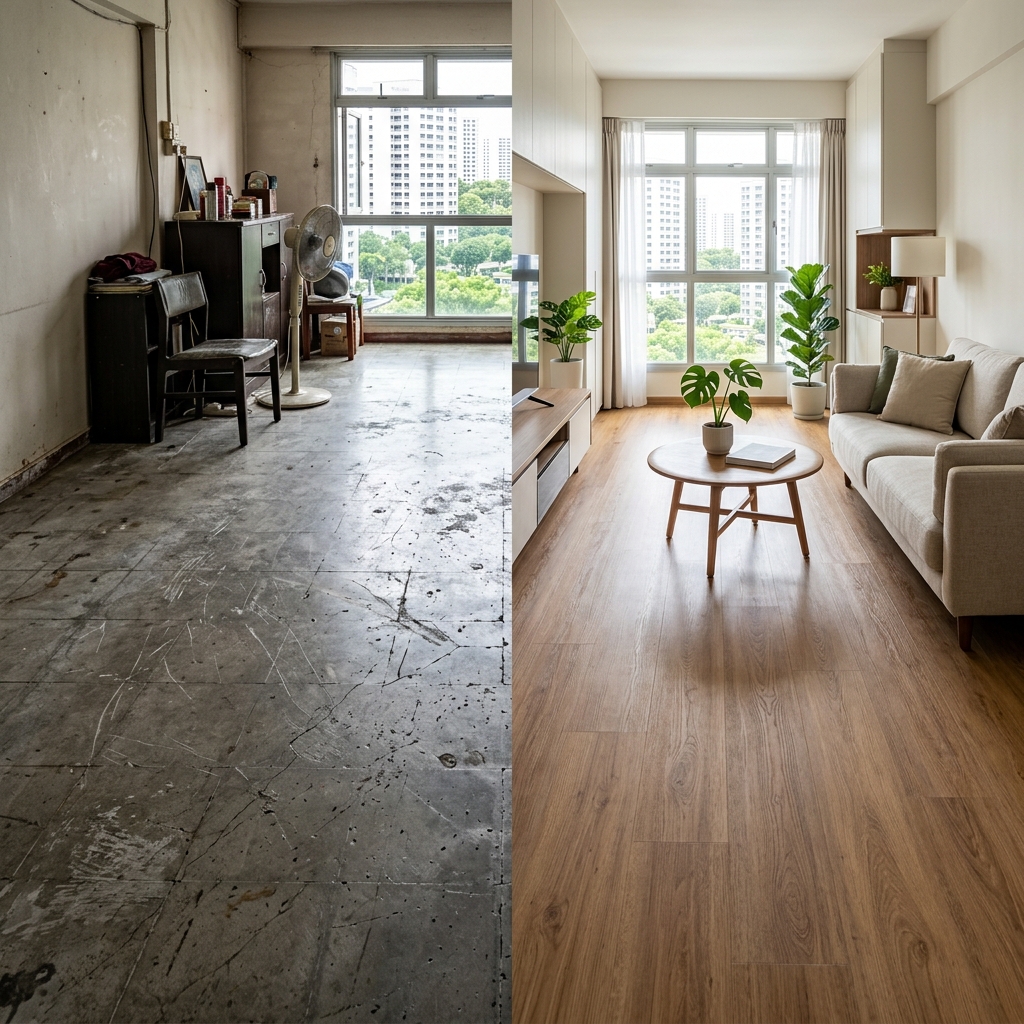
Yes — you can lay vinyl flooring directly over existing HDB tiles without hacking, and in most cases it delivers the same result in a fraction of the time and cost. Overlay installation uses click-lock SPC or LVT planks that float over the existing tile surface with no adhesive required. The key is knowing whether your tiles are suitable — here's exactly what to assess.
What Is Overlay Flooring?
Overlay flooring means installing new flooring on top of what already exists, rather than removing it first. Click-lock vinyl planks snap together and float as a single connected surface over the tiles below — no glue, no screws, no fasteners. This is why overlay is far faster than traditional renovation and produces no dust, no hacking noise, and no debris.
Does Your HDB Flat Qualify for Overlay?
Overlay works on most HDB floors, but a qualified installer should assess four things:
1. Tile Integrity
Press firmly on each tile and listen for a hollow sound. Hollow or loose tiles must be re-adhered before overlay can proceed. If more than 15% of tiles are hollow or damaged, tile hacking may be the better long-term choice.
2. Floor Levelness
Overlay requires the existing surface to be level within 3mm over any 1.8m span. Older HDB flats sometimes have significant lippage between tiles that must be levelled with self-levelling compound first.
3. Height Clearance at Doors
Overlay adds 5–7mm of floor height. Most HDB interior doors have enough clearance, but those with tight clearance will need the bottom planed down. LN Flooring includes door trimming as part of our standard overlay quote.
4. Room Type
Overlay is not suitable for bathrooms or wet kitchens with regular direct water contact on the floor. It is specifically designed for dry areas: living rooms, bedrooms, corridors, dining rooms, and study rooms.
LN Flooring's site assessment: We include a free site visit before every overlay quote. We check tile condition, floor levelness, and door clearances before providing a final price. No charge for the assessment.
Overlay vs Tile Hacking: Full Comparison
| Factor | Vinyl Overlay | Tile Hacking + New Floor |
|---|---|---|
| Cost (4-room HDB) | S$2,000–S$4,500 | S$5,000–S$10,000+ |
| Installation time | 1–2 days | 3–6 days |
| HDB approval needed | No | Notify town council |
| Neighbour disruption | Minimal | Significant (hacking noise) |
| Dust and debris | None | Significant |
| Can stay home during | Yes | Not recommended |
| Floor height change | +5–7mm | Typically no net change |
| Suitable for wet areas | No | Depends on material |
| Reversible | Yes (planks click out) | No |
How Much Does Overlay Flooring Cost in Singapore?
| Product Type | 3-room HDB | 4-room HDB | 5-room HDB |
|---|---|---|---|
| Economy LVT (5mm, 0.3mm wear) | S$1,600–S$2,200 | S$2,000–S$2,800 | S$2,400–S$3,200 |
| Standard SPC (6mm, 0.3mm wear) | S$2,000–S$2,800 | S$2,500–S$3,500 | S$3,000–S$4,000 |
| Korean SPC (6mm, 0.5mm wear) | S$2,500–S$3,500 | S$3,200–S$4,200 | S$4,000–S$5,000 |
Prices include supply, installation, skirting, and door trimming. Tile re-adhesion (if needed) is typically S$80–S$150 per tile.
The Overlay Installation Process
- Tile assessment and re-adhesion — loose tiles re-adhered before any planks are laid
- Floor levelling — height variations filled with levelling compound
- Layout planning — starting line marked, plank direction confirmed with homeowner
- Plank installation — click-lock planks installed from one wall outward, edge planks cut to size
- Skirting installation — skirting boards fitted to cover plank edges
- Door trimming — all affected doors planed at the bottom to restore clearance
- Final inspection and cleanup — walk-through with homeowner before completion
For a full timeline breakdown, see our HDB flooring installation timeline guide. For product specifics, read our SPC vs LVT comparison.
Is overlay suitable for your flat?
Answer 3 quick questions: