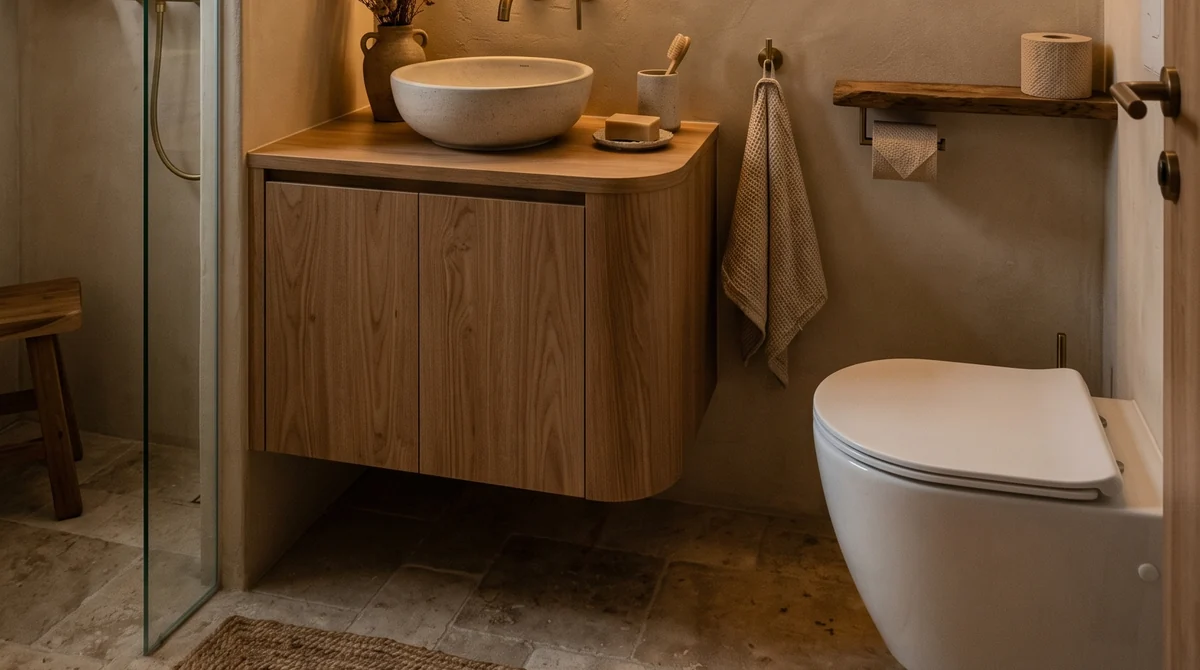
Wet areas are where flooring gets tested. Daily splashes, bleach, grease, standing water, floor traps, mop cycles all land on a slab that has to stay watertight for the next 20 years. After hundreds of HDB kitchen and bathroom installs across Singapore, our recommendation is simple: porcelain tile in the bathroom and kitchen wet zone, with vinyl LVT confined to the dry kitchen walking area if budget is the concern. We supply and install both, so one crew covers the whole flat. Here is why.
Why kitchen and bathroom rules are different
Bedrooms and living areas can run on overlay vinyl: no permit, one-day install, and the existing developer tile stays underneath. Wet areas can't. The bathroom slab in every HDB flat sits on a waterproofing membrane that must be inspected and reinstated whenever the floor finish changes. That means hacking, and hacking means an HDB renovation permit. The kitchen is a hybrid: most of the floor walks dry, but the sink, hob and washing-machine corners see standing water and grease that defeat a click-lock vinyl seam over time.
Use the wet-area suitability checker
Tap a zone in your HDB flat to see whether porcelain tile or vinyl LVT is the right call, and why.
Wet-area suitability checker
Pick a zone in your HDB flat
Bathroom
Constant standing water, floor trap, shower runoff
Non-porous, mould-resistant, slip-rated when matt finish is selected. Compatible with the waterproofing membrane below the slab.
Click-lock seams degrade with constant standing water. Floor trap cut-outs cannot be sealed reliably with LVT.
Kitchen wet zone
Under sink, hob, washing-machine corner
Handles grease, heat near the hob, and water from the sink and washing machine. Easy to wipe down.
Standing water from leaks creeps under the seam. Grease softens the click-lock edge over years.
Kitchen walking area
The dry centre of the kitchen, doorway, dining-side
One continuous tile through the kitchen looks better and avoids a transition strip in a small HDB layout.
Acceptable for the dry walking area only, as overlay over existing tile: no hacking, no permit, one day install.
Service yard
Open laundry area, often with floor trap
Standing water and rainwater splash through the grille, so the yard behaves like a half-bathroom.
Outdoor exposure plus floor trap make seams unreliable.
What it costs
Honest pricing from LN Flooring as a BCA registered contractor, valid for 2026 jobs. We do not publish a tile rate, because the tile you pick, the format and the condition of the existing floor all move the number, so tile is quoted per project after a site measure. You can see what we carry on our tile supply and installation page.
| Finish | Per sqft (supply & install) | Typical HDB kitchen (~7 sqm / 75 sqft) | Typical HDB bathroom (~4.5 sqm / 48 sqft) |
|---|---|---|---|
| Porcelain tile | Quoted per project after a site measure | ||
| Vinyl LVT (dry zone overlay) | S$3.20 to S$4.90 | ~S$240 to S$370 | Not suitable |
Hacking is always quoted separately and varies by floor and wall conditions, the number of pipes that need protection, and disposal arrangements. Skirting is always quoted separately regardless of finish.
HDB renovation permit: Hacking always requires an HDB renovation permit. We apply for it on your behalf as part of the quotation, so you never deal with HDB directly.
How long it takes
Tile installation in an HDB kitchen and bathroom takes 5 to 7 days when the unit is furniture-free, including hacking, screeding, waterproofing reinstatement, tile laying and grouting. With existing furniture in adjacent areas, plan for 1 to 2 weeks total. The bathroom is the critical path. Water connections are only restored after the waterproofing and grout cure.
Wet areas are where tile is non-negotiable, but they are not the only place it belongs. Plenty of owners run the same tile through the living room, a feature wall or the whole flat, and we install it there too. See the full range on our tile supply and installation page.
For the whole-flat picture (bedrooms, living, hallway), read our HDB Flooring Guide 2026, or compare the dry-area vinyl options in Best Flooring for HDB Bedrooms.