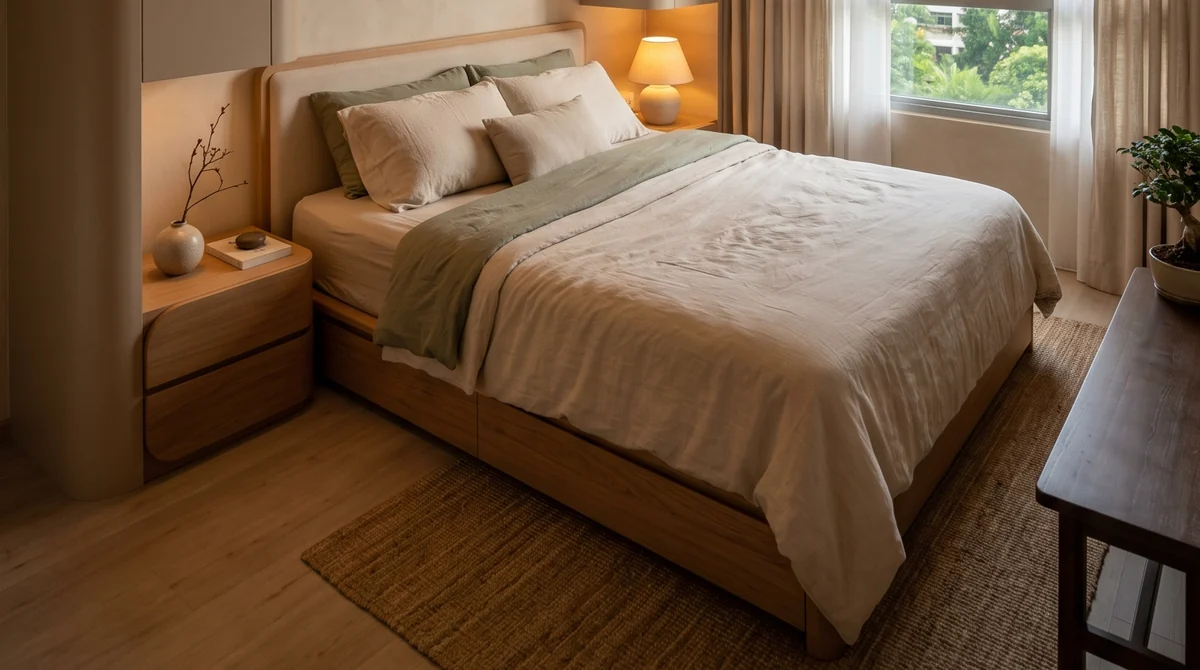
Laminate is one of the first floors people look at when they want the warm timber look without the price of real wood. It photographs well, it feels premium in a showroom, and it usually costs a little less per square foot than vinyl. All of that is real. What the showroom does not show you is how laminate behaves after a year of Singapore living: the weekly mopping, the year-round humidity, and the one spill nobody wiped up in time. As a BCA registered contractor that fits floors across HDB flats and condos, here is a straight guide to what laminate is, what it costs here, and the one question that decides whether it belongs in your home.
Is laminate right for this room?
Tap a room for the honest verdict and the waterproof alternative
Living room
High traffic, occasional spills, weekly mopping
Bedroom or study
The one place laminate genuinely suits
Kitchen
Splashes, spills, and frequent mopping
Bathroom or wet kitchen
Standing water, floor traps, constant damp
What laminate flooring actually is
Laminate is a layered product. At its heart is a core of high-density fibreboard, which is compressed wood. On top sits a printed photographic layer that carries the timber image, and over that a clear melamine wear layer that takes the scratches and scuffs. It clicks together as a floating floor, so it installs quickly over a flat subfloor. The build is clever and the look can be very convincing. The catch is the core: because it is a wood product, it reacts to water in a way the surface photo never hints at.
AC grades, and what they do and do not tell you
The number to know when you shop laminate is the AC rating, short for Abrasion Class. It grades how well the wear layer stands up to traffic and scuffing. AC3 is rated for general home use, AC4 for heavy home and light commercial, and AC5 for commercial spaces. For most homes AC3 to AC4 is the right range. Just remember what the AC rating covers: surface wear only. It says nothing about water, which is the property that actually matters in a Singapore home.
What laminate costs in Singapore
Price is laminate's headline appeal, so let us be specific. As a market estimate, laminate tends to sell for roughly S$2.50 to S$4.50 per square foot supply-only in Singapore before installation, depending on grade and thickness. That is usually a little below vinyl at the supply stage. The gap is real but small, and it closes once you add installation and, more importantly, once you look past year one.
For a like-for-like reference point, our own-brand waterproof LVT runs from S$3.20 per square foot for the Core series up to S$4.90 for the H Herringbone series, supply and install, with a 25-year material warranty. So the true comparison is not a cheap floor against an expensive one. It is a small up-front saving against a floor that cannot be damaged by the thing most likely to damage a floor here.
The humidity problem, which is the whole decision
Everything above is secondary to this. Laminate's fibreboard core swells when water reaches it, and that swelling is permanent. Water does not have to pool for hours. It finds the joints and the plank edges, soaks into the board, and the board expands and stays expanded. You are left with lifted edges and a wavy surface, and the only fix is to replace the affected planks, which in practice often means re-flooring the room.
Now put that material in a Singapore home. The floor gets mopped every week, the air is humid for most of the year, and every home eventually meets a spill, a leaking appliance or a wet-season surprise. This is why we treat water resistance as the deciding factor for flooring here, and why our waterproof flooring guide ranks the options by exactly that. If you want the head-to-head against the floor most people compare it with, our vinyl vs laminate guide lays it out factor by factor.
| Factor | Laminate | Wood-look LVT (vinyl) |
|---|---|---|
| Core material | High-density fibreboard (compressed wood) | Vinyl, no wood |
| Water resistance | Swells permanently once wet | 100% waterproof through the plank |
| Surface durability | Hard wear layer, graded by AC rating | Strong wear layer, repairable plank |
| Feel underfoot | Harder, can sound hollow | Warmer, quieter, softer |
| Up-front cost (est.) | Approx. S$2.50 to S$4.50 psf supply-only | From S$3.20 psf, supply & install |
| Suits Singapore humidity | Dry rooms only | Yes, every room except true wet areas |
LN supplies waterproof own-brand LVT, and does not carry laminate. We made that call on purpose: in Singapore's climate a waterproof floor is the safer recommendation for nearly every home. If you came in wanting the timber look that laminate gives, our wood-look LVT series deliver the same warm grain without the fibreboard core that swells, from S$3.20 per square foot for Core up to S$4.90 for the H Herringbone series, all supply and install with a 25-year material warranty and a 1-year workmanship warranty, from a BCA registered, bizSafe Level 3 contractor.
So where does laminate actually make sense?
In a strictly dry room where the budget is tight, laminate can do a fine job. A bedroom or a study that rarely sees water and is not mopped hard is its best case. The trouble is that most homes want one floor running through the living areas, and that floor has to survive the kitchen and the weekly mop as well as the bedroom. Once a single material has to cover all of it, the floor that also handles water wins by default. That is vinyl, and it gives you the same timber look, so you are not trading the look away to get the durability.
Read next
If you are weighing materials, our vinyl vs laminate guide is the direct head-to-head, and the waterproof flooring guide ranks every option by how it handles water. To go deeper on the vinyl side, the SPC vs LVT guide explains the two rigid-core formats, and the 2026 vinyl flooring buyer's guide ties the whole picture together. See the wood-look range on our flooring page, the tiles we carry on our tiles page, and when you are ready, send us your unit details for a quote per room.