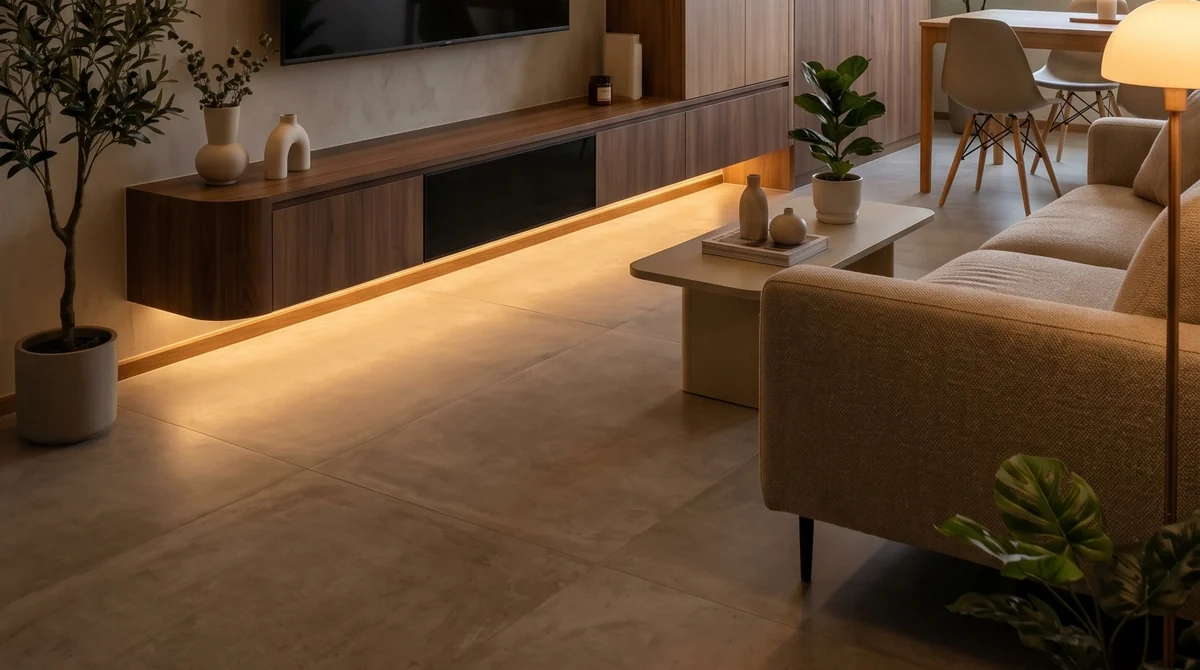
"Homogeneous tile" is one of the most-asked terms we get from Singapore homeowners, usually right after "isn't that the same as porcelain?" It mostly is, and mostly isn't, and the difference matters once you are choosing between a plain grey corridor tile and a marble-look living room floor at very different prices. As a BCA registered contractor supplying and installing tile across HDB flats, condos and commercial spaces, here is the honest breakdown of homogeneous, porcelain and ceramic tile, and which anti-slip rating actually matters for a wet area here.
Which tile type is this, really?
Tap a tile type for its make-up, durability and where it fits
Homogeneous (full-body, unglazed)
Colour runs through the whole tile, not just the surface
Glazed porcelain
A dense body with a printed, glazed decorative layer
Ceramic
A more porous body, usually glazed, lower cost
What "homogeneous tile" actually means
Homogeneous tile, sometimes called full-body or unglazed vitrified tile, is built so its colour and pattern run all the way through the tile, not just sit in a thin surface layer. That uniformity is where the name comes from. Because there is no separate glaze layer to wear through, a chip or scratch on a homogeneous tile shows the same colour underneath rather than a different-coloured body, which is exactly why it is the default tile across Singapore's HDB corridors, void decks and other high-traffic common areas. In fact, most homogeneous tile is dense enough to qualify as porcelain under the international standard: a water absorption of 0.5% or less, per ISO 13006. The distinction from what most people picture as "porcelain" is really about the surface finish and the design intent, not the underlying material science.
Glazed porcelain: where the design happens
Glazed porcelain shares the same dense, low-absorption body, but adds a printed and glazed top layer that can replicate marble, timber, concrete or almost any surface a designer wants. This is the tile category behind most of the marble-look and wood-look floors you see in Singapore show flats and renovation photos. The trade-off is that the decorative layer is thinner than the tile body, so a deep chip can occasionally expose a different colour underneath. For most homes this is a minor, largely cosmetic risk rather than a durability problem, and it is why glazed porcelain remains the default choice for living rooms and feature walls where the look matters most.
Ceramic: the affordable, lower-traffic option
Ceramic tile is fired at a lower temperature into a more porous body than porcelain, which makes it cheaper to produce but less hard-wearing underfoot. It is almost always glazed, which is where its colour and pattern come from, and it remains a sound, budget-friendly choice for walls, backsplashes and lower-traffic floor areas. For a Singapore living room, hallway or kitchen floor that takes daily footfall, though, homogeneous or porcelain will outlast it.
| Factor | Homogeneous | Glazed porcelain | Ceramic |
|---|---|---|---|
| Colour depth | Runs through the body | Thin printed/glazed layer | Thin glazed layer |
| Water absorption | ≤0.5% (porcelain-grade) | ≤0.5% (ISO 13006) | Higher, more porous |
| Chip resistance | Excellent, same colour underneath | Good, may reveal base colour | Fair |
| Design range | Simple, functional finishes | Marble, wood, stone, large-format | Wide, mainly wall-focused |
| Typical use | Corridors, void decks, utility areas | Living areas, feature walls | Walls, backsplashes, light-traffic floors |
| Cost tier (est.) | Most affordable | Mid to premium | Budget to mid |
The anti-slip rating that actually matters
Whichever tile type you land on, slip resistance is the spec that protects your household, and it is graded independently of tile type using an R-rating (R9 to R13) under the DIN 51130 "ramp test". As a general guide from Singapore tile supplier White Horse, R9 suits dry indoor areas like bedrooms, R10 is standard for general indoor areas including kitchens and hallways, and R11 is recommended for bathrooms, laundries and other areas that see regular water, including shower floors. R12 and R13 are higher grades built for commercial and industrial settings and are rarely necessary in a home. When you brief us on a wet-area job, we confirm the R-rating on the specific tile you choose, not just its type.
LN Flooring supplies and installs all three tile types. We source through Hafary and Soon Bee Huat, with the contractor discount passed direct to you, and quote per project because price depends on the tile, size and area covered. Full substrate waterproofing is standard on every wet-area job before a single tile goes down. See the full range on our tiles page, and note that tiles carry no product warranty from us or the manufacturer; our 25-year material warranty is specific to LVT vinyl.
So which should you pick?
For corridors, service yards and other spaces that take daily punishment, homogeneous tile is the practical, budget-conscious choice. For a living room, entryway or feature wall where you want a marble or timber look, glazed porcelain is where that design range lives. Ceramic remains a fair pick for walls and lower-traffic areas on a tighter budget. Whatever the type, match the R-rating to the room: R10 for general living areas, R11 for anywhere that gets wet.
Read next
For the fuller category picture, see our floor tiles Singapore guide, which covers sizes and formats room by room, and our tile supplier guide on how we source from Hafary and Soon Bee Huat. If you are weighing tile against vinyl, our vinyl vs tiles comparison lays out the trade-offs, and the waterproof flooring guide ranks every option by how it handles Singapore's climate. For small-format work, our mosaic tiles guide covers where the extra grout is worth it and where it becomes a cleaning job. Browse the full range on our tiles page, and when you are ready, send us your unit details for a quote per room.