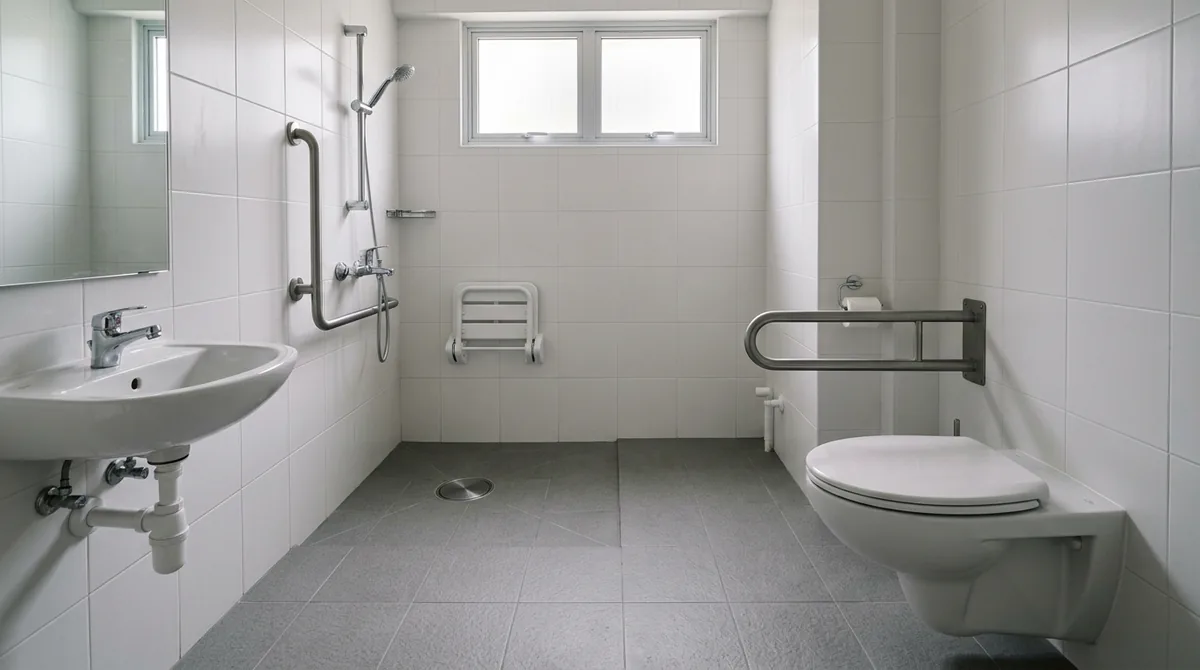
Anti-slip flooring in a Singapore flat comes down to two things: matt or textured tile with a proper slip rating where floors get wet, and a surface with some grip in the dry rooms. For families with elderly parents, start with the bathroom. Glossy existing tiles can be given a slip-resistant treatment without hacking, and HDB's EASE programme can subsidise most of the cost for eligible households with seniors. Then deal with what costs little, such as loose rugs and a dark route to the bathroom at night.
Where should you look first in the flat?
Walk the flat the way your parents use it, at night as well as in the day. These are the places worth checking.
- The bathroom. Water, soap and glossy tile together, often with bare feet.
- The kitchen. Water and oil around the sink and hob.
- The bathroom door. A step or lip, often crossed half awake.
- Loose rugs. Edges that curl, and rugs that slide on smooth tile.
- The corridor at night. A dim route between bedroom and bathroom.
What does anti-slip actually mean on a tile?
Tile slip resistance is usually given as an R rating, from R9 to R13, based on the German DIN 51130 ramp test. The higher the number, the more grip. Our homogeneous versus porcelain tiles guide sets out which rating suits which room, so ask for the rating of the exact tile you are shown.
The R rating is measured in shoes on an oiled ramp. Some tiles also carry a barefoot class, A, B or C, from a separate wet test done barefoot. For a shower floor that is the more telling figure, and C grips best.
The finish matters as much as the number. For a wet floor walked on barefoot, choose a matt or textured tile, never a polished one. The trade-off is cleaning. Texture holds more grime than a smooth face, so it needs a scrub brush now and then, not only a mop.
Can existing bathroom tiles be made less slippery?
Yes. A slip-resistant treatment is applied to the existing floor tiles, so nothing is hacked and the waterproofing underneath is left alone.
HDB's Enhancement for Active Seniors (EASE) programme can subsidise most of the cost of slip-resistant treatment for existing bathroom floor tiles, for up to two bathrooms, for eligible households with seniors. The treatment lasts a few years with proper cleaning. Check HDB's EASE page for current eligibility before you pay anyone for the same work.
If the bathroom needs redoing anyway, retiling lets you choose a matt, slip-rated tile and lay it over a fresh waterproofing membrane. That means hacking, which needs an HDB renovation permit, and a new flat has a three-year bathroom rule. Our HDB tiles guide explains both.
We supply tiles from Hafary and Soon Bee Huat, and our own crew lays them. We bring samples to the site visit, so you can wet one and feel the finish in your own bathroom before you choose. The range is on our tiles page.
Home slip check
Tick what is true of the flat. You get a rough level and a fix list, in the order we would tackle it.
Your slip check appears here.
What about bedrooms and the living room?
Polished tile looks good and turns slick in socks or under a spill. Embossed vinyl has more grip than polished tile and is warmer underfoot. Every wood-look series in our range has an embossed grain, our N Series has a slightly deeper grain texture, and our Urban Stone Series comes in matt and gloss finishes depending on the design. Our vinyl texture guide explains how texture changes grip.
Vinyl goes over the existing tiles with no hacking, and a dry-area overlay needs no HDB renovation permit. The tiles must be firmly bonded, level within 3mm across any 1.8m span, and free of cracked or lifting pieces. Popped tiles get fixed first, as our tile repair guide explains. Our vinyl flooring range runs S$3.20–S$4.90 psf supplied and installed.
A wet vinyl floor is still a wet floor, so wipe up spills promptly. Vinyl belongs in the dry rooms, and the bathroom stays tiled.
What happens at the bathroom door after an overlay?
An overlay raises the floor outside the bathroom by about 5–7mm, so the step down into the bathroom gets that much deeper. That edge gets a proper transition profile rather than a cut plank edge. Our crew also measures every door and trims any that would drag, on the day, at no extra charge.
The step keeps shower water in the bathroom, so light it well at night. If it is high, ask HDB about its EASE programme, which now also covers some changes at the bathroom entrance for eligible seniors.
What can you fix first?
- Loose rugs. Take them up, starting with the route from the bedroom to the bathroom.
- Night lighting. Plug-in or motion-sensor night lights along the corridor and at the bathroom door need no contractor.
- A bathroom floor that stays wet. A squeegee after showers helps. If water sits in a corner away from the floor trap, the floor may not slope properly to the trap, which is a job for a tiler.
- The kitchen. Wipe up water and oil as they happen, and keep the wet zone tiled.
Read next
- Homogeneous versus porcelain tiles with the slip rating each room needs
- Flooring for HDB kitchens and bathrooms and why the wet zones stay tiled
- Overlay flooring for HDB flats for the no-hacking route in dry rooms
- Our tile supply and installation service
Common Questions
A matt or textured tile with a suitable slip rating, laid over a waterproofing membrane. If the bathroom does not need redoing, a slip-resistant treatment can be applied to the existing floor tiles instead, without hacking, and HDB's EASE programme can subsidise most of the cost for eligible households with seniors. Vinyl is not the answer here, because a bathroom floor that gets wet every day stays tiled.
They come from the German DIN 51130 ramp test, in which a tester in safety shoes walks on an oiled ramp that is tilted until they start to slip. R9 is the lowest grip and R13 the highest. Our homogeneous versus porcelain tiles guide gives R10 for general indoor floors and R11 for bathrooms and other areas that are regularly wet. R12 and R13 are mainly for commercial and industrial floors.
Yes. HDB's EASE programme can subsidise most of the cost of slip-resistant treatment for existing bathroom floor tiles, for up to two bathrooms, for eligible households with seniors. The treatment lasts a few years with proper cleaning. Eligibility and what is covered can change, so check HDB's EASE page for the current rules before you arrange anything.
Embossed vinyl has more grip than polished tile and is warmer underfoot, which is why it suits bedrooms and living rooms. Every wood-look series in our range has an embossed grain, and our Urban Stone Series comes in matt and gloss finishes depending on the design. Like any floor, it is slippery with water or oil on it, so wipe spills up promptly, and keep the bathroom tiled.
Yes. An overlay raises the floor outside the bathroom by about 5–7mm, so the step down into the bathroom gets that much deeper. We finish that edge with a proper transition profile rather than a cut plank edge, and our crew measures every door and trims any that would drag, on the day, at no extra charge. A light at that doorway keeps the step easy to see at night.
A little. A matt or textured surface holds more grime than a smooth, polished one, so it needs a scrub with a brush now and then rather than only a mop. The upside is that matt tile hides water spots better than gloss. In the bathroom, a squeegee after showers stops the floor staying wet, whichever tile you have.
Planning ahead for your parents' flat?
Tell Kayler which rooms worry you. On a free site visit we will look at the floors and say plainly whether they need tile, vinyl or simply better lighting.
WhatsApp Kayler or call Kayler on +65 8118 5520