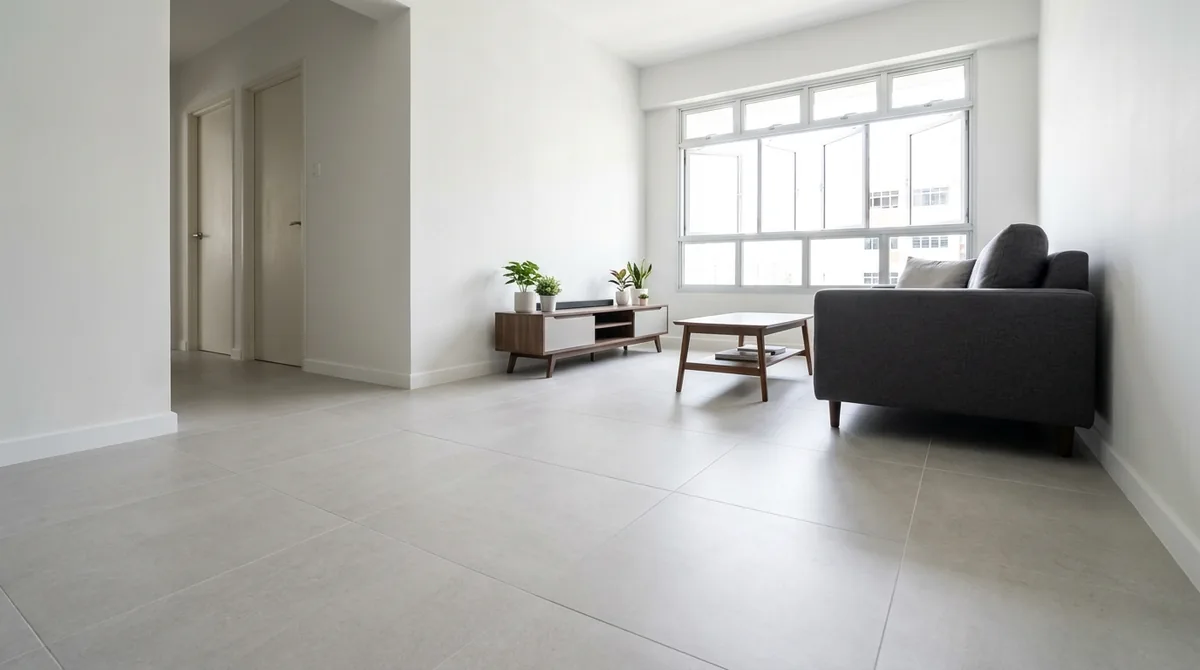
Most guides to HDB tiles are really guides to choosing a colour. The part that actually decides your timeline, your budget and whether you get a complaint from the unit below is regulatory: whether you need a permit, when your contractor is allowed to make noise, and whether the floor you want to hack is one HDB would rather you left alone. As a BCA registered contractor tiling HDB flats across Singapore, that is the part we get asked about last and should be asked about first.
Hack, or tile over?
Tick what applies to your flat. This is the same short assessment we run on a site visit.
When you need an HDB permit
Replacing floor or wall finishes is renovation work, and it needs an HDB permit. Two details catch people out. The first is that you cannot apply yourself. The application has to come from an HDB-registered renovation contractor, and the approved permit is displayed at the flat while the work runs. The second is that the permit is tied to a defined scope and period, so a job that quietly expands mid-way is a problem, not a favour.
None of this is difficult, and a contractor who tiles HDB flats weekly handles it as routine. It is worth knowing about because it is the step that sets your start date. If someone quotes you a start for next week without mentioning a permit, that is worth a question.
The hours that decide your timeline
This is the constraint people underestimate. Noisy work, meaning hacking, demolition and heavy drilling, is permitted on weekdays only, in a window that runs roughly 9am to 5pm. It is not allowed on Saturdays, Sundays or public holidays. Quieter work has a wider window, generally 9am to 6pm Monday to Saturday.
The practical effect: the loudest stage of your job can only happen five days a week. A hack that starts on a Thursday does not continue through the weekend. That is not a contractor being slow, and it is worth building into your expectations before you book a move-in date.
Tell your immediate neighbours before the hacking starts, not after. It costs nothing, and it is the difference between a neighbour who tolerates three noisy days and one who calls the town council on day one.
Hack and relay, or tile over the top?
Both are real options and we quote both. The honest summary is that tiling over is faster and quieter, and hacking is what most flats actually need.
Tiling over keeps the existing floor in place and lays new tile on top. You skip the hacking stage entirely, which means no demolition noise, far less dust and a shorter job. The costs are height and honesty: you add roughly 15 to 20mm to the floor once adhesive is counted, which eats door clearance and creates a step at thresholds, and you are covering up whatever is wrong underneath rather than fixing it. If any existing tile is drummy, that fault is now sealed under your new floor.
Hack and relay takes the old floor off, prepares the substrate properly, waterproofs where it needs waterproofing, and lays onto a known base. It is noisier, dustier, slower and more expensive. It is also the only route that lets anyone stand behind the result in a wet area.
If you want the no-hacking benefit without the height problem, the other route is not tile at all. It is a vinyl overlay over your existing tiles, which adds about 5mm rather than 20 and goes in inside a day.
The bathroom rule worth knowing before you plan
A new HDB flat comes with a waterproofing membrane under the bathroom floor, and that membrane carries cover for a limited period after handover. Hacking the bathroom floor breaks the membrane, and doing it inside the first three years generally forfeits that cover, which matters, because the consequence of a failed bathroom waterproofing job is not your flat, it is the ceiling of the one below.
If the original bathroom tiles in a new flat are not to your taste, changing the wall tiles only, or overlaying, keeps the floor membrane intact. In an older resale flat this restriction has long passed and a full hack-and-relay with fresh waterproofing is usually the right call.
Rules change and every flat is different. Treat the above as what to ask about, not as clearance, we confirm the specifics for your flat type and age before we commit to a quote, and we would rather lose a job than take a deposit for work that cannot be done properly.
Which tile suits which room in a flat
Tile is not one product. The three types you will be quoted behave differently, and the right answer changes by room. We go through this in more depth in our guide to homogeneous versus porcelain tiles, but the short version for an HDB flat:
| Room | What we usually lay | Why |
|---|---|---|
| Living & dining | Large-format glazed porcelain | Fewer grout lines make a small flat read larger, and the printed surface carries marble and stone looks convincingly. |
| Bedrooms | Porcelain, or vinyl instead | Low traffic and no water. This is the room where people most often choose vinyl for warmth underfoot and a faster job. |
| Kitchen | Glazed porcelain, matt finish | Grease and water want a surface that cleans easily but is not polished, which becomes slippery when wet. |
| Bathroom | Anti-slip rated porcelain or ceramic | The slip rating matters more than the look here. Wall tile can be a different, lighter product from the floor. |
| Corridor & entry | Homogeneous | Colour runs through the body, so a chip does not show a different colour underneath. Built for traffic. |
| Service yard | Anti-slip porcelain | Constantly wet, rarely looked at. Choose for grip and drainage falls, not appearance. |
What it costs, and why we do not publish a rate
We quote tile per project rather than at a headline rate per square foot, and that is a deliberate choice rather than evasion. Two flats of the same size can differ by thousands depending on how much hacking is involved, whether the substrate needs levelling, how many wet areas need waterproofing, and which tile you pick, the tile itself can vary several-fold between a plain corridor homogeneous and a large-format marble-look porcelain.
What we can tell you plainly is where the money goes: tile supply, hacking and disposal, substrate preparation, waterproofing, laying, grouting. We source through Hafary and Soon Bee Huat and pass the contractor discount straight through, and the site visit that produces the number is free.
For comparison, our vinyl is published: LN's LVT range runs S$3.20 to S$4.90 psf supplied and installed. If budget is the deciding factor and the room is dry, that comparison usually answers itself.
One thing tile does not come with
Tile carries no product warranty. We supply and install it but we are not the tile manufacturer, and standard porcelain and ceramic from Singapore suppliers is sold without a multi-year product warranty, material defects are assessed on delivery, before anything is laid. The 25-year material warranty you will see elsewhere on this site is LN's own cover on our LVT vinyl range, and it does not extend to tile. Anyone telling you your tiles are warranted for a decade is worth a second question.
Read next
- Homogeneous vs porcelain tiles, which of the three tile types belongs in which room
- Overlay flooring for HDB, the no-hacking route, and whether your flat qualifies
- Vinyl vs tiles, an honest comparison from a contractor who fits both
- Our tile supply and installation service