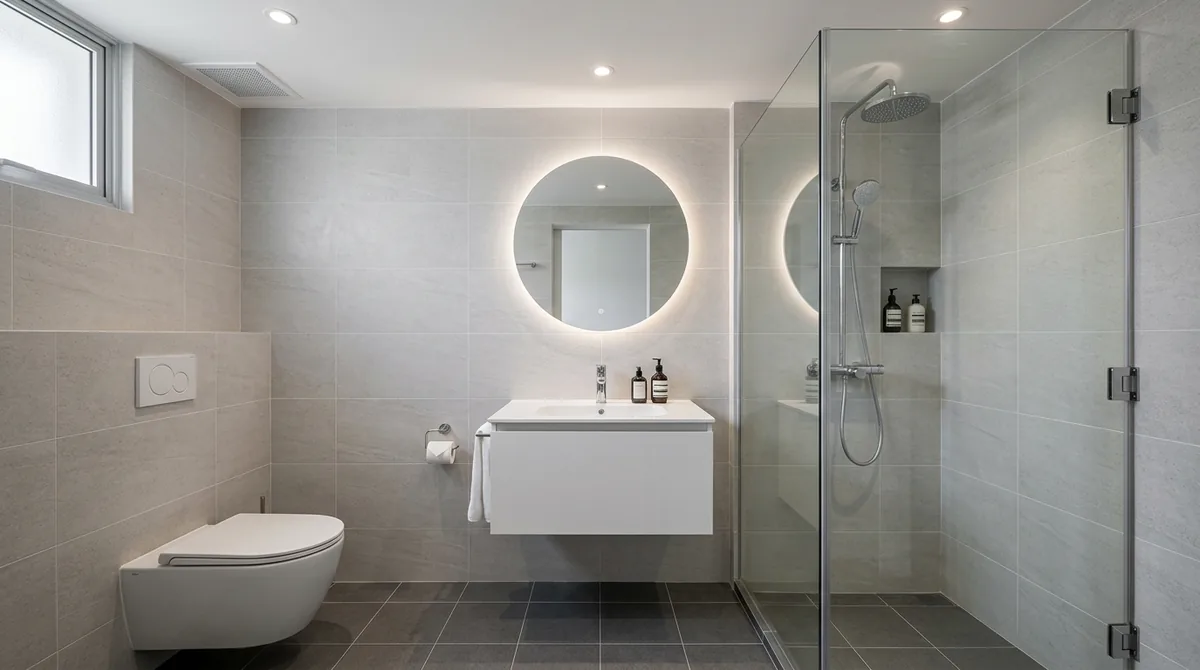
Wall tiles and floor tiles are different products. A wall-only ceramic tile is lighter, with a softer glaze, and it must never go on a floor; porcelain can go on either. For a Singapore bathroom the usual wall tile is 300x600, in gloss if the room is small and short of light, or matt if water spots bother you. Behind the shower, the waterproofing goes on before any tile does.
What is the difference between a wall tile and a floor tile?
A floor tile has to take footsteps and dropped pots for years, so it is made dense and hard. A wall tile only has to stay put and look good. That lets a wall-only ceramic be lighter, with a more porous body and a softer glaze, which is fine on a wall and wears through quickly underfoot.
| Wall-only ceramic | Porcelain | |
|---|---|---|
| Body | Lighter and more porous | Dense, absorbs almost no water |
| Glaze | Softer, often glossy | Harder, in gloss, matt or textured finishes |
| On a wall | Yes, its natural place | Yes, though large formats are heavy and need a flat wall |
| On a floor | Never | Yes, with a slip rating to suit the room |
So a porcelain floor tile can run up a wall, but a wall-only ceramic can never come down onto a floor. If the box or the spec sheet says wall only, believe it.
Which size of wall tile suits a Singapore bathroom?
300x600 is the usual bathroom wall size in Singapore. It is easy to handle and keeps the grout to a manageable amount in a humid room.
600x1200 has half the joint length of 300x600, so there is less grout to clean. It needs a flat wall, because a big tile shows every dip behind it, and a slip while cutting around a tap or a niche wastes a large piece.
Small formats such as a 75x150 subway tile add character and pattern. They also add grout: four times the joint length of a 300x600 per square metre. For even smaller pieces, our mosaic tiles guide covers where that much grout earns its place.
Wall tile calculator
Enter one wall, or for a whole bathroom, the room's perimeter as the width and the door as an opening.
Buy every tile from one batch, because the shade can shift between production runs, and keep a few spares for future repairs. Window reveals are tiled too, so add their area back.
Gloss or matt tiles on a bathroom wall?
A wall needs no slip rating, which leaves you free to use gloss. In a small bathroom with one window, gloss bounces what light there is around the room, and it wipes clean easily.
Matt hides water spots and soap splashes, which dry into visible marks on gloss around the shower. You can also split it: matt inside the shower, where the spots land, and gloss elsewhere. The floor is a separate decision, and it needs grip.
Should wall tile joints be stacked or offset?
A stacked layout lines the joints up in a straight grid. It reads calm and modern, but it shows every error, because one tile out of line breaks a joint that runs the full height of the wall.
An offset layout shifts each row, like brickwork, and forgives small variations better. On long tiles such as 300x600, a one-third offset is safer than a half. A pressed tile carries a slight bow, and a half offset puts the high middle of one tile beside the low end of the next. Our tiling contractor checklist explains that bow and the lippage it causes.
Then line the wall up with the floor. When the wall tile shares a module with the floor tile, such as a 300x600 wall over a 600x600 floor, the joints can run from the floor straight up the wall. Where they cannot line up, set out from the wall you see first when the door opens, so the narrow cut pieces end up in the corner behind it.
What goes behind the tiles in a bathroom?
Around the shower, the most important layer is the one you never see. Wet areas get a waterproofing membrane before tiling, on the floor and up the shower walls. Tile and grout shed most of the water, and the membrane stops the rest from soaking into the wall behind.
If you are changing bathroom tiles in an HDB flat, the permit and the three-year rule on hacking bathroom floors in new flats are set out in our HDB tiles guide.
Tile or panel for a feature wall?
Any wall that gets wet should be tile. For a dry feature wall in a living room or bedroom, our fluted Vellera Groove wall panels are the other option we fit, and our feature wall comparison sets panel, tile and paint side by side.
What about kitchen walls?
The same rules apply, with oil as the extra enemy. A smooth glazed tile, narrow joints and a darker grout behind the hob do most of the work. Our kitchen wall tiles guide covers the hob wall in detail.
Can new wall tiles go over old ones?
On sound, firmly stuck tiles, yes, and it saves hacking. It also adds the thickness of a tile and its adhesive. That shows at the edges: around window reveals and door frames, where the new tile can stand proud of the frame, and at switches and sockets, which need bringing forward.
Tap the old tiles before deciding. A hollow sound means a tile has come away from the wall, and anything laid over it inherits the problem.
How is a wall tile job quoted?
We supply tiles from Hafary and Soon Bee Huat, and our own crew lays them. Tile is quoted per project. WhatsApp Kayler your room and rough wall sizes for a same-day supply-and-install estimate, and we will bring samples to the free site visit so you see them in your own light. The range is on our tile supply and installation page.
Read next
- Kitchen wall tiles for the wall behind the hob
- Feature walls with panel, tile and paint compared
- Tile repair for hollow, cracked and popped tiles
- Our tile supply and installation service
Common Questions
Not if they are wall-only. A wall-only ceramic tile is lighter, with a softer glaze and a more porous body, because it never has to take foot traffic. On a floor it scratches, chips and wears through. Porcelain is different: it is dense enough for walls and floors, so a porcelain tile can go on either. Check the spec sheet before any tile goes on a floor.
Usually, yes. Porcelain floor tiles can go on walls, and running one tile from the floor up the wall is a common look. They are heavier than wall tiles, so large formats such as 600x1200 need a flat wall and the right adhesive, and usually two people to set them. Smaller floor tiles behave much like wall tiles once they are up.
300x600 is the usual bathroom wall size in Singapore. It is easy to handle and keeps the grout manageable in a humid room. 600x1200 means fewer joints but needs a flat wall. Small formats such as a 75x150 subway tile add character, and four times the grout of a 300x600, so they suit a single feature area better than a whole bathroom.
Gloss bounces light around a small bathroom and wipes clean easily, and a wall needs no slip rating, so gloss is a fair choice there. Its weakness is water spots, which dry into visible marks around the shower. Matt hides them. If you want both, use matt inside the shower and gloss elsewhere, and keep the floor matt for grip.
Keep a few from the same batch once the job is done, stored flat and dry. If a tile cracks years later, the range may have changed or been discontinued, and a tile from a different batch can differ in shade. Buy the spares on top of the calculator figure, which allows 10% for cuts and breakage on a straight grid and 15% on an offset or pattern.
We quote tile per project rather than at a published rate, because the tile you choose and the cutting around fixtures both change the price. WhatsApp Kayler at +65 8118 5520 with the room and rough wall sizes for a same-day supply-and-install estimate. The site visit is free, and the itemised written quote follows within 24 hours of it.
Retiling a bathroom wall?
Send Kayler the room and rough wall sizes on WhatsApp. We bring Hafary and Soon Bee Huat samples to the free site visit, so you can choose size and finish in your own light.
WhatsApp Kayler or call Kayler on +65 8118 5520