Tiles that sound hollow underfoot. A ridge at one joint you catch a toe on. Grout gone grey along the shower. A damp patch on the ceiling below. Most of them are not tile faults, several do not show on handover day, and each was decided by work that got covered up before you saw it.
Four defects account for most of that, and each has a question behind it that a competent tiling contractor answers without pausing. We lay tile in Singapore homes ourselves, so this is the list we would put to a tiler if we were the ones hiring. It is deliberately narrow: the stage-by-stage account of what the job involves, and how a quote should be itemised, is in our floor tiling guide.
Hollow tiles: what a tiling contractor should say about adhesive coverage
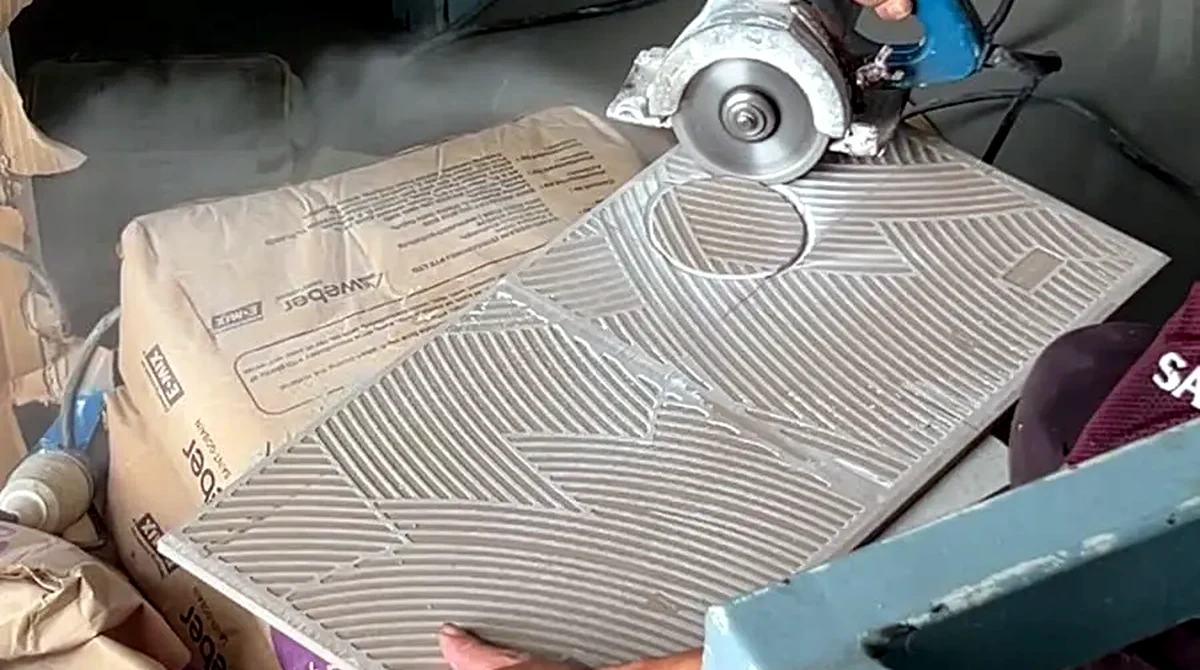
Tap a tiled floor with a knuckle or a coin. A properly bedded tile answers with a dull thud. A hollow one rings, which means the adhesive is not in continuous contact with the back of the tile, and the void underneath is where it later cracks, loosens or lifts. Five causes cover most of it:
- Spot bonding. A few dabs of adhesive instead of a full combed bed. Faster, less material, and most of the tile ends up supported by air.
- The wrong trowel. Ridges too shallow for the tile size, so they never collapse into full coverage under the tile.
- Adhesive left open too long. In Singapore heat a combed bed skins over fast, and a tile set on skinned adhesive sits on a crust.
- No back-buttering on large format. A 1200 by 600mm Italgraniti porcelain, or the 2500 by 1200mm Gigacer slab, is never dead flat, so without adhesive on the tile as well the centre stays unsupported.
- A dusty or unprimed substrate. The adhesive sticks to the dust, and the dust lets go of the screed.
Ask it bluntly: what adhesive coverage do you work to, and do you back-butter large format? Then ask to tap-test before grouting, while a defect is still cheap. Afterwards, fixing a hollow tile means cutting it out and disturbing its neighbours.
Lippage, and the joint width to agree before laying starts
Lippage is the height difference between two adjacent tiles. People notice it with their feet before their eyes, and it is a common handover argument because nobody agrees a standard beforehand.
Three things drive it. The substrate, because tile follows whatever is underneath, so the base has to be sound, clean and flat before anything is laid. The tile, because pressed tiles carry a slight bow, which is why large format needs levelling clips and why a brick-bond offset landing a joint at the centre of the tile below exaggerates that bow. And the joint width, because a narrow joint has nowhere to absorb a height difference: a 2mm joint on a 1200mm tile leaves no margin.
The tolerance a tiler works to is set against the joint width rather than as one figure for every job, so a contractor who promises no lippage at all on large format has not laid much of it. Get the joint width and the tolerance onto the quote, then check the finished floor with a long straightedge and with a light held low and raked across it, which shows a ridge that is invisible under a ceiling light.
Grout: the specification nobody raises at quoting stage
Cement grout is porous. In a shower or a kitchen it absorbs soap, oil and dirt, and a pale grout in a wet area darkens unevenly no matter how well the tiles were laid. Homeowners then blame the tiler for a specification decision nobody discussed.
Cement grout is cheaper and fine in dry rooms, particularly in a mid-tone that does not show every mark. Epoxy costs more in material and labour, because it sets fast and has to be cleaned off the tile face before it does, but it is effectively non-porous and resists staining and mould considerably better. That makes it the sensible pick in showers, around a hob, and in mosaic work, where there is far more grout per square metre than with large tile. Ask which is priced into your quote and in what colour, because the word grouting on its own tells you nothing.
Movement joints: the gap that stops tiles lifting off the screed
Tiles, screed and the building expand and contract at different rates, and that movement has to go somewhere. If a tiler grouts hard up to every wall and runs an unbroken field of tile across a whole flat, the floor has nowhere to move, and a row of tiles lifts off the screed with a bang, usually along a wall or across a doorway.
Three places need attention: a perimeter gap around the edge of the floor, left free of grout and hidden under the skirting; a joint where the floor changes substrate or passes through a doorway; and balconies or any tile in direct sun, where the daily temperature swing is far larger than indoors. It gets skipped because it takes time and nobody sees it once the skirting is on. Ask where the movement joints are going before work starts.
Wet areas in Singapore: the R-rating, and who carries the leak
A membrane failure shows up on the ceiling of the flat below, and putting it right means hacking out a finished bathroom floor a second time. The scope to get in writing (which rooms, how many coats, how high up the wall, and whether the floor is flood-tested before tiling) is set out in our floor tiling guide, and the three-year rule on hacking a bathroom floor in a new HDB flat is covered in our HDB tiles guide.
Two things to settle here. Specify the anti-slip rating on the tile itself: R10 for general indoor areas, R11 for bathrooms and any floor that is regularly wet, as set out in our comparison of homogeneous and porcelain tiles. And get the liability period for a wet-area leak written into the quote rather than agreed verbally, because a leak into a neighbour's unit is where a vague verbal warranty stops being an abstraction.
What to check about the tiling contractor, not the tiling
Ask whether the crew on site are the firm's own employees. A workmanship warranty is only worth what the firm that issued it can be held to, and where tiling is passed to an outside crew, the firm that took your deposit can point at someone you never met. Our tile is laid by our own crew, employed by a BCA registered firm. The generic vetting checks are in our guide to choosing a flooring contractor. LN Flooring is operated by LN Contractor Pte. Ltd., UEN 202532767H, bizSAFE Level 3 certified and a BCA Registered Firm for public sector works (CR06 Interior Decoration and Finishing Works, Grade L1). Look the UEN up rather than trusting a logo on a quote. Hacking HDB tiles always needs an HDB renovation permit, which has to be applied for by an HDB-registered renovation contractor; we handle it as part of the job.
On warranty, two flat facts. Tile carries no product warranty: standard porcelain and ceramic is sold that way in Singapore, we are the installer rather than the maker, and any defect is assessed on delivery before a tile is laid. Our 25-year material warranty applies to the LVT vinyl range only, not to tile. We buy through Hafary and Soon Bee Huat on a contractor account and pass that discount direct rather than marking a shop price up, which is not the same as being the cheapest raw tile in Singapore if you are willing to shop and haggle yourself. The comparison that holds is against paying full retail and then hiring a separate installer.
The site visit is free. We bring samples so you see the colour in your own light, tap-test the existing floor and check the wet areas while we are there, and you get a written quote within 24 hours. Finished work is in our project gallery, and the full service is on our tiles page. WhatsApp Kayler on +65 8118 5520 with your unit type and the rooms you are tiling, or send the details through our contact form. If you already have another quote, send that too and we will tell you which of the checks above it leaves out.
Common questions
A hollow ring means the adhesive is not in continuous contact with the back of the tile. The usual causes are spot bonding with a few dabs instead of a full combed bed, a notched trowel too small for the tile size, adhesive left open so long in the heat that it skins over before the tile is set, no back-buttering on large-format tiles, or a dusty or unprimed substrate. A hollow tile is not always loose today, but the void underneath is where it eventually cracks or lifts. Ask to tap-test the floor before grouting, while a fix is still cheap.
There is no single figure that applies to every job. The tolerance a tiler works to is set against the joint width, so a floor laid with a 2mm joint on a 1200mm tile is held to a tighter standard and leaves far less room to absorb the natural bow of a pressed tile. The practical answer is to agree the joint width and the tolerance in writing before work starts, then check the finished floor with a long straightedge and with a light raked low across the surface, which shows a ridge that overhead lighting hides.
Contractually, whoever installed the waterproofing, which is why the scope and the liability period belong in the quote before work starts rather than in an argument afterwards. The flat owner above is normally responsible to the neighbour, and recovers the cost from the contractor if the waterproofing failed. For an HDB flat the first call is HDB; in a condo it is the MCST. The repair means hacking out a finished bathroom floor a second time. Ask which rooms are waterproofed, how many coats, how high up the wall the membrane goes, whether the floor is flood-tested before tiling, and how long the contractor stands behind it.