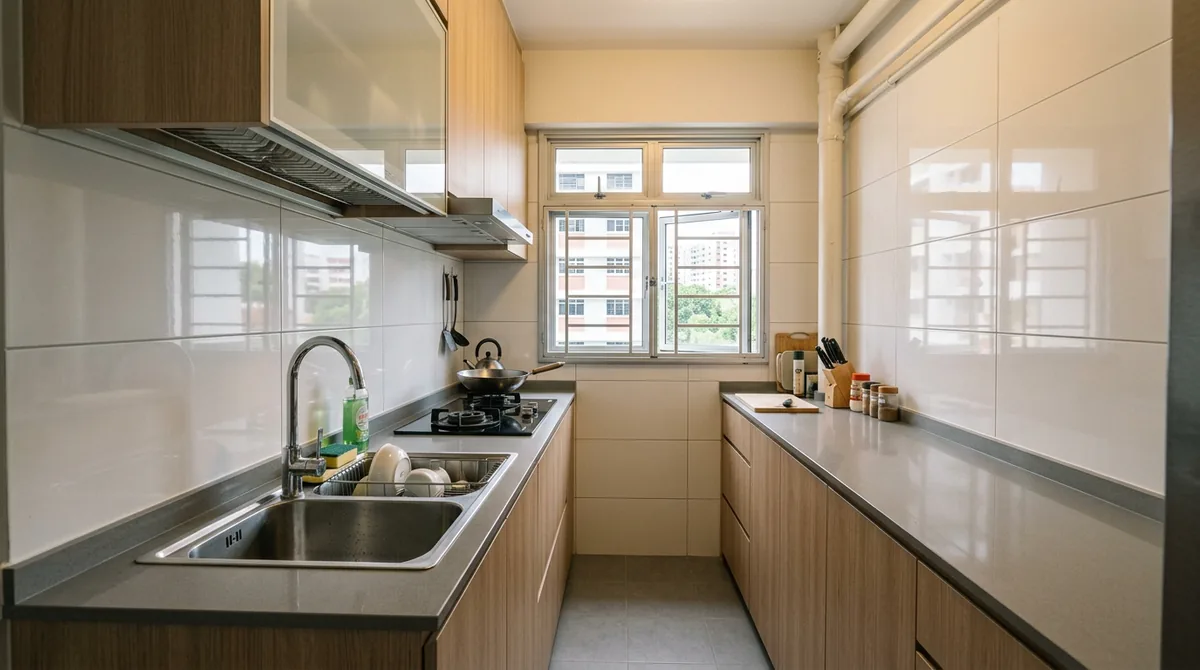
For most Singapore kitchens, the wall tile that lasts is a glazed tile with a smooth face, usually 300x600, laid with narrow joints and a grout dark enough not to show oil. Glazed ceramic wall tile is made for exactly this, and porcelain works too. The tile itself rarely fails on a kitchen wall. The grout behind the hob does, so most of the choices below come back to the joints.
Why is a kitchen wall harder on tiles than a bathroom wall?
A wok on high heat throws a fine oil mist that settles on everything within reach, and the wall beside the hob catches most of it. Steam from the pots and the rice cooker keeps that wall damp. Then it gets scrubbed, often with degreaser.
A bathroom wall mostly sees water and soap. Grease is harder on a wall, because it works its way into anything porous.
Ceramic or porcelain for a kitchen wall?
Either will do. A glazed ceramic wall tile is lighter than porcelain, with a softer glaze, and that is fine on a wall because nobody walks on it. Wall-only ceramic belongs on walls and should never be laid on a floor.
Porcelain is denser and absorbs almost no water, so it can go on a wall or a floor. Our guide to homogeneous, porcelain and ceramic tiles explains the materials properly.
What size of tile suits a kitchen wall?
300x600 is the common choice in Singapore kitchens. It keeps the joint count sensible and is more forgiving of an imperfect wall than a large format.
Subway formats such as 75x150 or 100x300 add character, and a lot more grout. A 75x150 tile has four times the joint length per square metre of a 300x600, and you feel that every time you clean behind the wok.
Large formats such as 600x1200 halve the joints of a 300x600. The catch is the wall. A big tile shows every dip behind it, and every socket and switch becomes a cut through a large, heavy piece.
Backsplash planner
Pick how you cook, where the tile goes and its size.
Gloss or matt tiles for a kitchen wall?
Gloss wipes clean in one pass and bounces light along a narrow HDB galley, which helps when the only window is at one end. Its weakness is streaks. Wipe it with a damp cloth and light from the side shows every stroke.
Matt hides streaks and water marks, which is why it suits the wall behind a sink. The trade-off is texture: oil settles into a textured matt face and needs a brush rather than a cloth. If you prefer matt near the hob, ask for a smooth matt or satin glaze rather than a structured one.
We bring Hafary and Soon Bee Huat samples to the site visit. Hold the gloss one beside your kitchen window when we do. Side light is what shows streaks, and it is the light your kitchen actually has.
What grout should go behind the hob?
Grout is the part of a kitchen wall that ages. The glaze shrugs off oil, but cement grout is porous and soaks it up, darkening unevenly from the hob outwards. Four choices slow that down:
- Keep the joints as narrow as the tile's edges allow.
- Pick a mid or dark grey grout over white, so the first months of cooking do not show.
- For a kitchen that fries most days, consider epoxy grout, which holds its colour far better. Our mosaic tiles guide covers its extra cost and slower laying.
- Where the tile meets the worktop, use silicone instead of grout. The two surfaces move differently, and a grouted corner cracks.
Clean with a degreaser made for tiles. Strong acid cleaners eat into cement grout.
Tile, glass or quartz behind the hob?
You will usually be offered two alternatives for the hob wall: tempered glass or a quartz upstand. We supply neither, so here is a plain comparison.
| Finish | Joints to clean | Next to the flame | If it gets damaged |
|---|---|---|---|
| Tile | Many, so the grout needs care | Handles heat well | One tile can be cut out and replaced, if you kept spares |
| Tempered glass | None | Handles heat. Socket cut-outs are made before tempering, so measure exactly | The whole panel is replaced |
| Quartz upstand | None along the wall | Check the maker's heat guidance: the resin is the weak point beside a gas flame | Small chips can be filled; a crack means a new piece |
Should the tiles go full height or stop at a 600mm band?
A band covers the strip between the worktop and the wall cabinets, roughly 600mm tall, with painted wall above it. It uses fewer tiles and suits a kitchen where cabinets cover most of the wall anyway.
Full height costs more in tile and cutting, especially around a window and the cooker hood. In return there is no painted strip near the hob to stain, and the whole wall cleans the same way. In a kitchen that fries often, we would at least take the hob wall to full height.
Can new tiles go over old kitchen wall tiles?
Often, if the old tiles are sound and firmly stuck, with no hollow-sounding patches. New tiles can then go over them without hacking. The new layer adds the thickness of a tile plus its adhesive, and that shows at the edges. Window reveals need finishing, and switches and sockets have to be brought forward so their plates sit on the new tile.
If the old tiles have to come off, hacking kitchen wall tiles in an HDB flat needs a renovation permit. Our HDB tiles guide covers how that works.
How is a kitchen wall tile job quoted?
We supply tiles from Hafary and Soon Bee Huat, and our own crew lays them. Tile is quoted per project, because the tile you choose and the cutting your wall needs both move the number. Send Kayler a photo of the kitchen and rough wall measurements on WhatsApp for a same-day supply-and-install estimate, and browse the range on our tile supply and installation page.
Changing the floor too? Our guide to the best flooring for HDB kitchens and bathrooms covers it.
Read next
- Mosaic tiles and where epoxy grout earns its extra cost
- Best flooring for HDB kitchens and bathrooms if the floor is changing too
- Our HDB tiles guide on permits and when hacking is needed
- Our tile supply and installation service
Common Questions
A glazed tile with a smooth face that wipes clean in one pass. Glazed ceramic wall tile is made for walls and works well, and porcelain works too. 300x600 is the common size in Singapore kitchens. Behind the hob, pick gloss or a smooth satin finish, keep the joints narrow and use a mid or dark grey grout, or epoxy grout if you fry most days.
Gloss wipes clean of oil in one pass and reflects light along a narrow kitchen, but it shows streaks and water marks when light comes from the side. Matt hides streaks, which suits the wall behind a sink, but a textured matt face holds oil. Near the hob, a smooth matt or satin glaze is the middle ground if you dislike the shine of gloss.
A mid or dark grey. Cement grout is porous and soaks up oil, so a white grout behind a wok darkens unevenly, starting nearest the flame. Epoxy grout is effectively non-porous and holds its colour far better, at a higher cost and with slower laying. Whichever you choose, the joint where the tile meets the worktop should be silicone rather than grout.
Usually, yes. Porcelain floor tiles can go on walls, and running one tile from the floor up the wall is a common look. They are heavier than wall tiles, so large formats need a flat wall and the right adhesive. The reverse does not work: a wall-only ceramic tile should never be laid on a floor, because it is not made to take foot traffic.
Often, if the old tiles are sound and firmly stuck. Tiling over them avoids hacking. The new layer adds the thickness of a tile and its adhesive, so window edges need finishing and switches and sockets have to be brought forward to sit flush. Hollow or cracked tiles should come off first, and hacking wall tiles in an HDB flat needs a renovation permit.
We quote tile per project rather than at a published rate, because the tile you choose and the cutting your wall needs both change the price. WhatsApp Kayler at +65 8118 5520 with a photo of the kitchen and rough wall measurements for a same-day supply-and-install estimate. We bring Hafary and Soon Bee Huat samples to the free site visit, and the itemised written quote follows within 24 hours of it.
Planning a new kitchen wall?
Send Kayler a photo of your kitchen and the rough wall size. We bring Hafary and Soon Bee Huat samples to the free site visit, so you can judge gloss and grout colour in your own light.
WhatsApp Kayler or call Kayler on +65 8118 5520