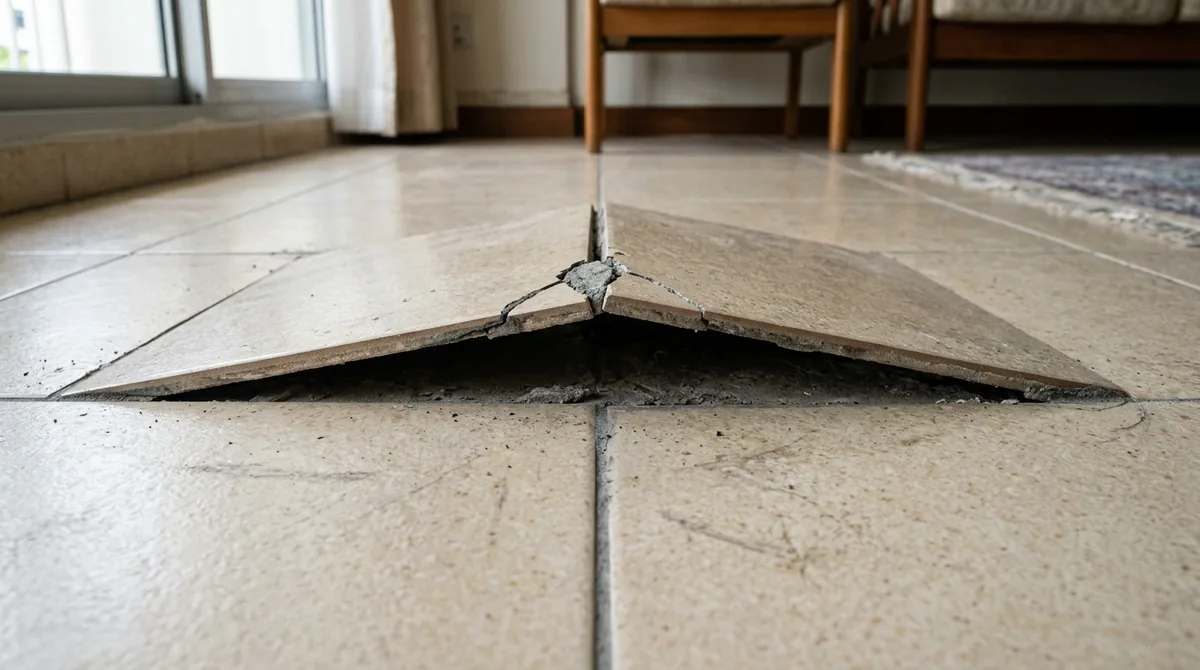
If tiles in your flat have popped up, sound hollow or have cracked, there is an order to dealing with it. First, keep everyone off any tile that has lifted. If the flat is under 15 years old, check with HDB before you pay anyone. Then let the number of tiles decide the repair. One or two loose tiles can usually be lifted and re-laid. A patch is better replaced as a section. When hollow tiles run across a whole room, retiling it is the sound fix. If you would rather cover it with vinyl, every hollow tile has to be re-laid first, and on a floor failing room-wide that can come close to retiling, so weigh the two at the site visit.
Why do floor tiles pop up?
Singapore's Ministry of National Development has explained the causes in Parliament: differential thermal expansion and contraction, and the bond between tile and screed deteriorating with age.
Put simply, a tile and the cement screed under it expand and shrink by slightly different amounts as the temperature changes. Over the years, the bond holding them together weakens. Once enough of it lets go, neighbouring tiles press against each other and lift into a tent along their shared joint, sometimes with a loud crack.
How the floor was laid matters too, as our guide to screening a tiling contractor explains.
What should you check first?
Do a tap test. Knock across the floor with a knuckle or the edge of a coin. A hollow sound means the tile has debonded: it has come away from the bed beneath it, even if it still lies flat.
Mark each hollow tile with a strip of masking tape as you go. The pattern tells you more than any single tile. Two taped tiles by the window is a small job. A trail of tape across the room is a different conversation.
Then deal with anything unsafe. A tented tile often cracks along its raised edge, and that edge can be sharp. Keep children and older family members off it, and cover the spot with a chair or a box. Do not stand on the tile to push it back down. It will not stick again, and it may break. Take dated photos before anything is moved.
Will HDB pay to fix popped tiles?
Flat owners are responsible for maintaining their flats, but there are exceptions. According to the Ministry of National Development's answers in Parliament, HDB repairs dislodged original tiles during the one-year defects liability period. The ministry has also said that HDB has offered goodwill repairs for dislodged original HDB tiles in flats up to 15 years old, and that for older flats, HDB can inspect and help remove affected tiles while owners engage a contractor.
If your flat is under 15 years old, check with HDB before you book anyone. What HDB will do depends on your flat and can change, and only HDB can confirm it.
Popped tile triage
Four answers, one likely route. A starting point, not an inspection.
Your likely repair route appears here.
Can one or two loose tiles be fixed on their own?
Usually. The grout around the loose tiles is cut out, the tiles are lifted, and the old adhesive is scraped off the tile backs and the floor. The tiles are then bedded on fresh adhesive and regrouted. If they come up whole, the same tiles go back down.
The catch is breakage. A tile that has been stuck down for years does not always come up in one piece, and a cracked tile needs replacing. Older tiles are often discontinued, so finding a perfect match, not the labour, is the real problem in tile repair.
If you kept a box of spares from the original job, this is what it was for. If not, some owners borrow a tile from somewhere out of sight, such as under the fridge, and put the nearest match there instead. That tile has to come up in one piece too, so it does not always work. Expect the new grout to look cleaner than the old for a while.
When is it better to replace a whole section?
When a patch is hollow or lifting, fixing it tile by tile tends to chase the problem across the floor. Tap around the patch first. The tiles beside a popped one can be hollow too, and the repair should stop where the tiles sound solid.
Replacing a section means lifting that area as one job and laying it again. With enough spares, it goes back in the original tile. Without them, it will be new tile, so decide where its edges fall. A section that ends at a doorway or along a kitchen counter looks planned. A square of new tile in the middle of the living room looks like a repair.
When should you retile the room, or cover it with vinyl?
When the tape runs across a room, the bond under that floor is failing in many places, and spot repairs tend to keep coming back. Retiling means hacking out the old floor, which needs an HDB renovation permit, and our HDB tiles guide covers what that involves.
Laying vinyl over the old floor is the other route, but only once the loose tiles are fixed. An overlay needs tiles that are firmly bonded, level within 3mm across any 1.8m span, and free of cracked or lifting pieces. On installation day our crew secures any loose tile edges before the first plank goes down. That is a finishing step, not a repair for tiles that have popped, which is why those get fixed first. The full checklist is in our overlay flooring guide.
An overlay adds about 5–7mm to the floor height, and our crew measures every door and trims any that would drag, on the day, at no extra charge. It is for dry rooms only. A bathroom with popped tiles stays a tile repair.
If the repair turns into retiling a room, or you would rather cover the old floor with vinyl, that is work we quote for. We supply tiles from Hafary and Soon Bee Huat, our own crew lays them, and we bring samples to the site visit so you see them in your own light. The range is on our tiles page, and the no-hacking route is on our HDB vinyl overlay page.
Read next
- Screening a tiling contractor for the adhesive questions that stop tiles going hollow
- Overlay flooring for HDB flats with the full checklist your tiles must pass
- Our HDB tiles guide on hacking permits and the three-year bathroom rule
- Our tile supply and installation service
Common Questions
Singapore's Ministry of National Development has explained in Parliament that the causes are differential thermal expansion and contraction, and the bond between tile and screed deteriorating with age. In practice, a tile and the screed under it expand and shrink by slightly different amounts as temperatures change, and over the years the bond weakens until neighbouring tiles push each other up along a joint. How the floor was first laid can play a part too.
It depends on the flat. Owners are responsible for maintaining their flats, but according to the Ministry of National Development's answers in Parliament, HDB repairs dislodged original tiles during the one-year defects liability period, has offered goodwill repairs for dislodged original HDB tiles in flats up to 15 years old, and for older flats can inspect and help remove affected tiles while owners engage a contractor. These arrangements can change, so check with HDB first, especially if your flat is under 15 years old.
Not always. A hollow tile has come away from the bed beneath it, but while it still lies flat it is usually something to plan for rather than an emergency. Mark hollow tiles with masking tape so you can see how far the problem runs, and watch for any that start to lift or crack. A tile that has already tented up is different: the raised edges can be sharp, so keep people off it until it is repaired.
That is often the hardest part of a tile repair, because older tiles are frequently discontinued. Use spares from the original job if you kept any. If not, some owners borrow a tile from somewhere out of sight, such as under the fridge, and put the nearest match there instead. For a bigger repair, make the new tile a planned section that ends at a doorway or a counter line, so it reads as a choice rather than a patch.
Not until they are fixed. A vinyl overlay needs a floor that is firmly bonded, level within 3mm across any 1.8m span, and free of cracked or lifting pieces. On installation day our crew secures any loose tile edges, but that is a finishing step, not a repair for popped tiles. Once the loose tiles are re-laid, vinyl can cover the old floor in a dry room with no hacking, adding about 5–7mm to the floor height.
It depends on how many tiles are affected, whether you have spares, and whether the job grows into a section or a whole room, so tile work is quoted per project. If the repair is turning into a retile, WhatsApp Kayler at +65 8118 5520 with photos and the room size for a same-day supply-and-install estimate. If you would rather cover the floor, our vinyl runs S$3.20–S$4.90 psf supplied and installed. The site visit is free.
Tiles popping in your flat?
Send Kayler a few photos and tell us how old the flat is. If the repair is turning into a retile or a vinyl overlay, we will quote for it after a free site visit.
WhatsApp Kayler or call Kayler on +65 8118 5520