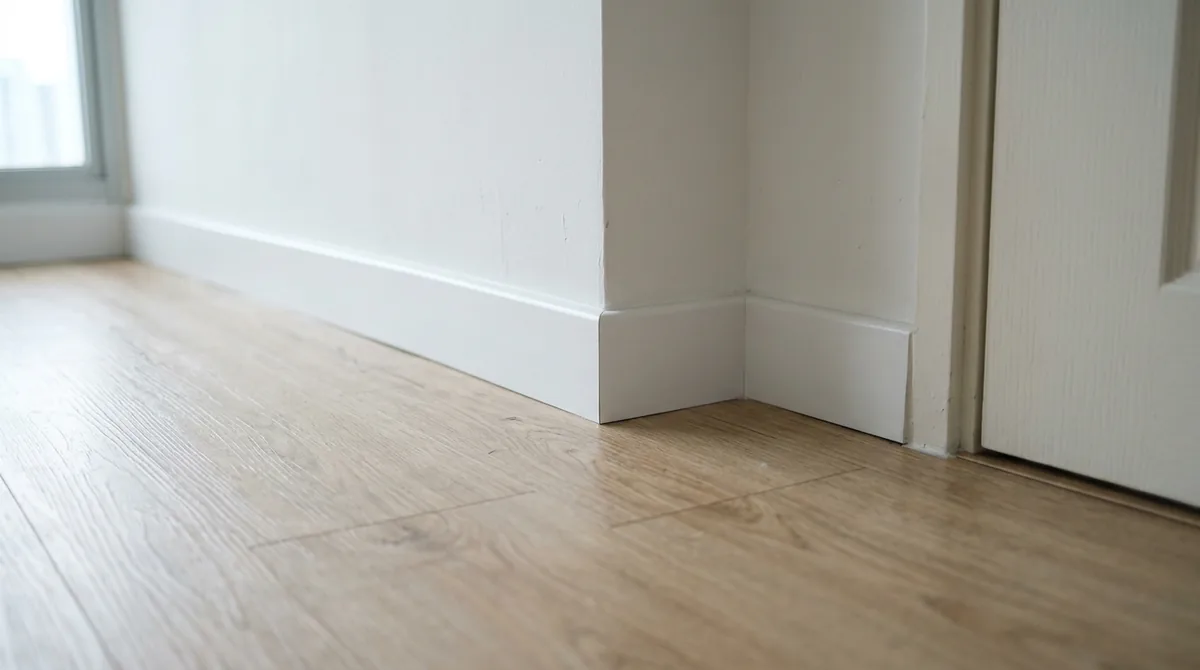
When the floor changes, the skirting decision comes with it. There are three routes: keep the existing skirting if the floor itself is staying, remove it and fit new PVC skirting (sold as vinyl skirting), or fit new skirting over the old. In the most common Singapore case, a vinyl overlay in a flat with tile skirting, our default is the third: the new skirting goes over the tile skirting, so nothing is hacked out. On every vinyl job we do, the skirting is reinstalled or replaced on the day.
"Do you redo the skirting?" is one of the two questions we are asked most often on WhatsApp. The other is whether the doors will need trimming. Both come down to the same few millimetres: a vinyl overlay raises the floor by about 5–7mm, and everything that meets the floor has to work around that.
What does skirting actually do on a vinyl floor?
Skirting, or skirting board, looks like trim, but on a vinyl floor its main job is to hide a gap. A click-lock vinyl floor floats over the surface below. It is not glued down, so it needs a small gap at every wall to expand and contract with temperature, and the skirting covers that gap.
It also tidies the wall base, where plaster rarely meets the floor in a straight line, and it takes the daily knocks from mops and vacuum heads that would otherwise scuff the paint.
Should you keep, replace or cover the old skirting?
| Route | When it fits | What to know |
|---|---|---|
| Fit new over the old | Sound tile skirting, with a vinyl overlay going down. | Our default for tile skirting. Nothing is hacked, and the new skirting sits slightly proud of the old line. |
| Remove and fit new PVC | Timber, MDF or old PVC skirting, or tile skirting you want gone. | Timber, MDF and PVC come off without hacking, though the wall base may need touching up. Tile skirting has to be hacked off, with dust, extra cost and wall patching. |
| Keep the existing skirting | The floor is staying. (With a vinyl overlay we always refit or cover the skirting, because the floor needs a gap at the walls.) | Nothing is hacked or refitted. If the skirting is sound, there is no need to touch it. |
That slightly proud line is a trade most of our customers prefer to the dust and cost of hacking tile skirting off. Fitting over does set one rule: the new skirting must be tall enough to hide the old one. Measure your tile skirting from the floor. The overlay raises the floor by about 5–7mm, so the new skirting needs to be at least that measurement minus 5mm, and in practice we round up to the next standard height.
Which skirting route suits your home?
Answer three questions to see the route we would suggest.
At the base of your walls now
What is happening to the floor
You want the skirting to
Fit new PVC skirting over the old tile skirting, in your wall colour.
This is our default for tile skirting: the new skirting goes over the old one, sitting slightly proud of the old line, and hides the gap the floating vinyl needs at the walls. Hacking the tile skirting off is the alternative, but most of our customers would rather avoid the dust and cost. In a colour close to your walls, it fades away and the floor reads wall to wall.
On the day: The vinyl goes down first, then the new skirting is fixed over the old, tall enough to hide it. Every door is measured and any that would drag is trimmed, at no extra charge.
How tall should skirting be in an HDB flat?
The usual heights are 60mm, 80mm and 100mm, and in a compact HDB room the difference shows.
- 60mm is the quiet option. It suits a small bedroom with built-in wardrobes, where a taller skirting competes with the carpentry. It will not hide a taller old skirting.
- 80mm is the middle ground, and the safe choice when there is no old skirting to cover.
- 100mm has more presence and suits a bigger living room. It is also the height you may need to cover a tall tile skirting.
Should skirting match the wall or the floor?
This is the "disappear or frame" question from the helper above.
Wall-matched skirting fades into the wall, so the floor seems to run wall to wall. In a small room, that calm edge is often the better choice.
White draws a crisp line around the floor and sits well with white door frames and carpentry. It shows grey marks from mop heads sooner, though PVC wipes clean.
Floor-matched skirting, in a tone close to the vinyl, makes the floor look as if it turns up the wall. It only works when the match is close. A near miss looks like a mistake.
Is PVC skirting better than wood in Singapore?
For most homes, yes, and the reason is water. MDF and untreated timber take on moisture at the bottom edge, where the mop lands every day, and in our humidity they can swell. Once that happens, the paint cracks along the edge and the board starts to pull away from the wall.
PVC does not absorb water, so it stays straight through years of mopping and wipes clean. Keeping the skirting line dry still matters, as our vinyl cleaning guide explains. You will also see aluminium skirting on the market, usually as a slim metal profile.
What happens to the skirting on installation day?
The skirting goes on once the planks are down. It appears as its own line on the itemised written quote. Transitions between rooms get matching profiles, and our crew measures every door and trims any that would drag, on the day, at no extra charge.
The full sequence is in our HDB flooring installation timeline, and whether your tiles can take an overlay at all is covered in our overlay flooring guide. Rates by series are on our HDB vinyl overlay page. If you are retiling instead, skirting cut from the same tile is the usual finish, and our tile supply and installation service covers that side.
Read next
- Overlay flooring for HDB flats, and the checks your tiles must pass first
- How long HDB flooring installation takes, from first plank to final walkthrough
- The 2026 vinyl flooring buyer's guide, covering series, wear layers and prices
- Our HDB vinyl overlay service
Common Questions
For a vinyl floor, usually yes. A floating vinyl floor needs a small gap at every wall, and the skirting is what covers it. On every vinyl job we do, the skirting is reinstalled or replaced on the day, and it appears as its own line on the itemised quote. If the new floor is tile, skirting cut from the same tile is the usual finish.
Yes, and with a vinyl overlay it is our default. The new skirting goes over the tile skirting rather than the old one being hacked out. It sits slightly proud of the old line, and most of our customers prefer that to the dust and cost of removing it. It has to be tall enough to hide the old skirting, so measure the old one from the floor first.
80mm is a comfortable middle height for most HDB rooms. 60mm is quieter and suits small bedrooms with a lot of built-in carpentry, while 100mm has more presence in a bigger living room. If the new skirting is going over an old tile skirting, the old one sets the minimum: measure it from the floor and subtract 5mm, since the overlay raises the floor by about 5–7mm. In practice we round up to the next standard height.
For most homes, yes. MDF and untreated timber take on moisture at the bottom edge from daily mopping and humid air, and they can swell, crack their paint and pull away from the wall. PVC does not absorb water, so it stays straight and wipes clean. Timber can still look good in a room that is never wet-mopped, but PVC is the lower-risk choice.
Match the wall if you want the skirting to disappear and the floor to read wall to wall, which suits a compact room. Choose white if you want a crisp frame around the floor. Floor-matched skirting only works when the colour match is close, because a near miss looks like a mistake. Holding samples against your own wall tells you more than any photo.
Because the floor needs room to move. Click-lock vinyl floats over the surface below instead of being glued down, so it needs a small gap at every wall to expand and contract with temperature. Planks pushed tight against a wall can lift or buckle. The skirting covers that gap, which is why it goes on after the planks are down.
Some will. The overlay raises the floor by about 5–7mm, so a door with little clearance underneath can start to drag. Our crew measures every door and trims any that would drag, on the day, at no extra charge. Our overlay flooring guide explains how much clearance HDB doors usually have and what changes after an overlay.
Not sure what to do with your skirting?
Send Kayler a photo of the base of your walls and tell us what the floor is changing to. We will confirm the route at the free site visit, and you get an itemised written quote within 24 hours.
WhatsApp Kayler or call Kayler on +65 8118 5520