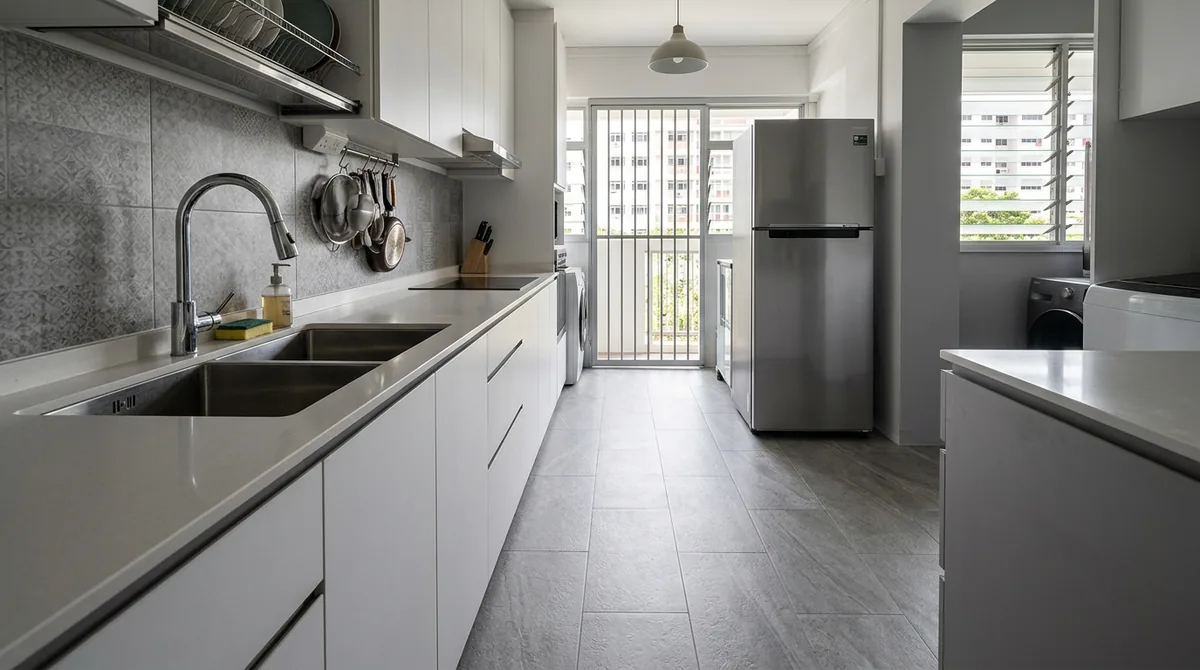
Yes, vinyl flooring works in a kitchen, as long as the kitchen is dry. Where you cook, wipe up spills and clean with a wrung-out mop, vinyl suits the walking area well. Any corner where water stands, usually by the sink, the hob or the washing machine, should stay tiled, and a kitchen that is hosed down or bucket-washed toward a floor trap should stay tiled throughout. The plank itself is 100% waterproof. What goes wrong is water getting under its edges.
Our kitchen and bathroom flooring guide draws the same line: porcelain tile in the wet zone, vinyl confined to the dry walking area. The useful question is where that line falls in your own kitchen.
Is your kitchen dry or wet?
Many condo floor plans label it for you: an open dry kitchen for light cooking and an enclosed wet kitchen for the wok and the washing up. Most HDB flats have one kitchen, and the way you use it decides.
The test is the mop, not the floor plan. If the floor is cleaned with a wrung-out mop and spills are wiped as they happen, the walking area is dry. If water is poured, hosed or pushed across the floor toward the floor trap, the kitchen is wet for flooring purposes, however light the cooking.
How does water get under a vinyl floor?
Our vinyl is click-lock and floats over the surface below. Water on top wipes off. Water that reaches the edges and seams can run underneath, where it has nowhere to drain and dries slowly. In a kitchen, it usually gets there one of these ways:
- The sink. An overflow, or a slow drip from the pipes in the cabinet, runs along the plinth and reaches the plank edges first.
- Machines. A dishwasher or washing-machine leak happens out of sight, under or behind the machine, and can run for days before anyone notices.
- Bucket mopping. Sloshing water across the floor drives it into the seams. A wrung-out mop does not.
What about the floor trap?
If your kitchen has a floor trap and water is sent to it, treat the kitchen as wet and keep it tiled. Where a trap only takes the odd rinse, keep a generous tiled area around it, with a profile where the vinyl meets it.
A trap also needs water poured in now and then to keep its seal against drain smells, so the floor around it is never truly dry.
Which parts of your kitchen suit vinyl?
Choose how your kitchen floor gets cleaned, then tap a zone.
Kitchen zones
Vinyl suits the dry walking area. Keep tile at the sink, the hob, the machines and the floor trap.
Sink run: Keep tile. Keep tile in front of the sink. Overflows, drips from the dish rack and leaks inside the cabinet all land here, and standing water defeats a click-lock seam over time.
Can vinyl take the heat and oil by the hob?
Heat first. A pan straight off the flame belongs back on the hob or on a trivet, never on the floor, because concentrated heat can mark a vinyl surface. If one drops, lift it away at once rather than leaving it where it landed.
Oil is the daily issue. A thin film of oil is slippery while fresh, and grease left to build up works into plank seams over time. Wipe spatter the same day, and keep tile in front of the hob, where grease and spills land every day. Our vinyl cleaning guide lists the cleaners that are safe to use.
Which vinyl suits a kitchen best?
Every series we sell is 100% waterproof on the surface and carries the same 25-year material warranty. For kitchens, though, we point people to the LN Urban Stone Series, which our flooring page calls "the natural fit for kitchen floors". It has marble-, cement- and terrazzo-effect designs in matt and gloss finishes depending on the design, and tile formats including 450x900mm, with four-sided micro-bevelled edges so each joint reads like a real tile joint.
A kitchen floor that looks like tile still reads as a kitchen, even when it is the same material as the living room next door. Urban Stone is S$4.00–S$4.40 psf, supply and install, and our marble-look vinyl guide covers the range in more depth.
One floor into the living room, or a change at the door?
In a dry kitchen, the same vinyl can run straight through from the living room with no threshold, which suits a compact flat where the kitchen opens off the dining area. The alternative is a change at the kitchen doorway, such as wood-look planks in the living room and Urban Stone in the kitchen, joined by a matching transition profile.
A profile also finishes every edge where vinyl meets tile that stays, at the floor trap, the washing machine or the service-yard door. If the kitchen has a door, our crew measures it and trims it on the day if it would drag, at no extra charge. Tiling the whole kitchen is never the wrong answer either, and our tile supply and installation service covers that.
Can vinyl go over your existing kitchen tiles?
Usually, if the tiles pass the same check as any overlay: firmly bonded, level within 3mm across any 1.8m span, and free of cracked or lifting pieces. Tap the tiles near the sink first, since that is where years of water are most likely to have worked underneath. Our overlay flooring guide covers the full check.
The overlay adds about 5–7mm, which matters for anything that slides under a worktop. A washing machine or dishwasher moved onto vinyl would sit that much higher, which is one more reason to keep tile under the machines.
Read next
- Best flooring for HDB kitchens and bathrooms, and why the wet zone stays tiled
- Waterproof flooring compared, room by room
- Marble-look vinyl flooring, the Urban Stone range in more depth
- How to clean vinyl flooring, and the cleaners that are safe to use
Common Questions
In a dry kitchen, yes, for the walking area. Vinyl is 100% waterproof on the surface and easy to wipe. Corners where water stands, usually by the sink, the hob or the washing machine, should stay tiled, and a kitchen that is hosed down or bucket-washed should stay tiled throughout. The risk is not the plank itself but water getting under its edges.
We would not. A wet kitchen that is hosed or bucket-washed sends water across the floor and into every seam, and a floating vinyl floor has no way to drain it. Porcelain tile over a waterproofing membrane, laid to fall toward the floor trap, is the right floor there. Vinyl can still go in the dry rooms around it.
Not close to it. If your kitchen has a floor trap and water is sent to it, treat the kitchen as wet and keep it tiled. Where a trap only takes the odd rinse, keep a generous tiled area around it, with a profile where the vinyl meets it, because a cut-out around a floor trap cannot be sealed reliably. The trap also needs water poured in now and then to keep its seal against drain smells, so the floor around it is never truly dry.
It can. Concentrated heat can mark a vinyl surface, so a pan straight off the flame belongs on the hob or a trivet, never on the floor. If one drops, lift it away at once. Normal cooking heat in the room is not the problem; a hot object resting on the surface is.
We point kitchens to the LN Urban Stone Series. It comes in tile formats including 450x900mm, in matt and gloss finishes depending on the design, and has four-sided micro-bevelled edges so the joints read like real tile joints. Our flooring page calls it the natural fit for kitchen floors. It is S$4.00–S$4.40 psf supply and install, 100% waterproof on the surface, with a 25-year material warranty like the rest of our vinyl.
Usually, if the tiles are firmly bonded, level within 3mm across any 1.8m span, and free of cracked or lifting pieces. Tap the tiles near the sink first, where water may have worked underneath over the years. The overlay adds about 5–7mm, which matters for a machine that slides under a worktop. Keep tile under any washing machine or dishwasher, where a hidden leak would reach the plank edges.
Planning vinyl for your kitchen?
Tell Kayler how your kitchen floor gets cleaned and where the floor trap and washing machine sit. At the free site visit we check your tiles for overlay and show you where the vinyl should stop.
WhatsApp Kayler or call Kayler on +65 8118 5520