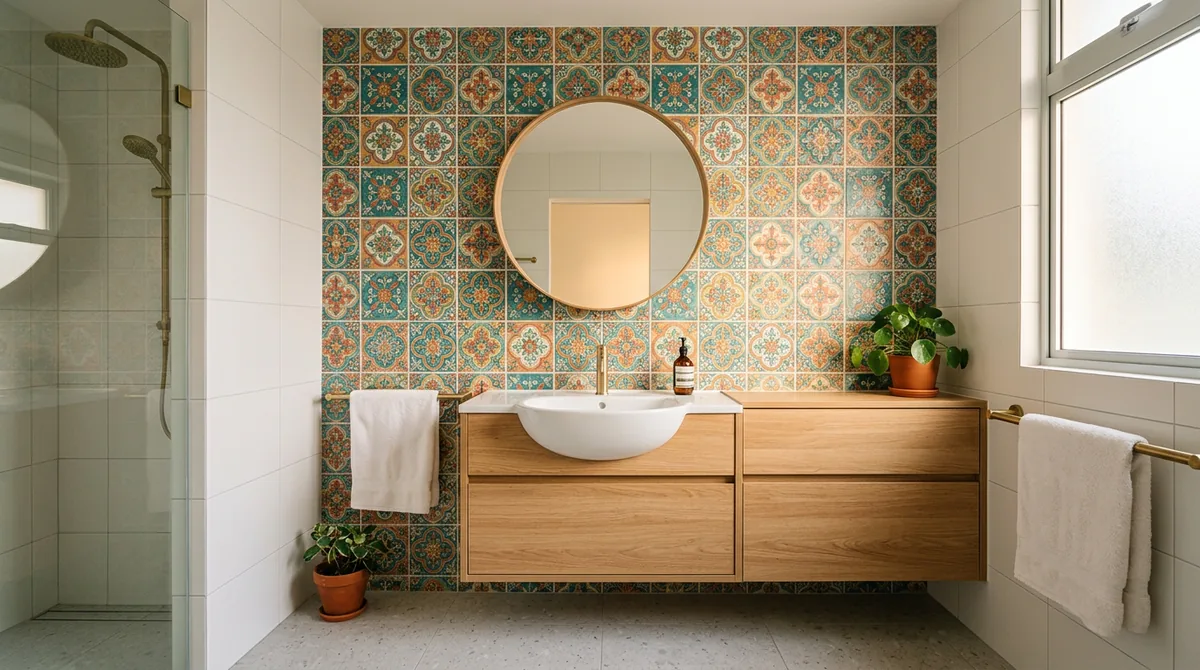
Peranakan tiles are the decorative patterned tiles associated with Singapore's Peranakan shophouses. You can buy the look new in three forms: glossy glazed ceramic or porcelain, mostly for walls; cement (encaustic-style) tiles; and matt floor-rated porcelain. In a modern HDB flat or condo they work best in one framed spot, such as the wall behind a vanity or a backsplash band. Across the whole floor of a small room, they overwhelm it.
What makes a tile "Peranakan"?
The originals were early 20th-century majolica tiles, many imported from England and later from Japan. Today the name covers any tile in that spirit: dense, colourful patterns, many of them designed so that four tiles meet to complete one motif.
What kinds of Peranakan-style tiles can you buy today?
Three different products are sold under the name, and they behave differently.
| Type | What it is | Upkeep | Where it suits |
|---|---|---|---|
| Glossy glazed ceramic or porcelain (mostly wall tiles) | A new tile made to echo the originals, with the pattern in a glossy glaze | Wipes clean. Porcelain is the tougher of the two | Walls. Many are wall-only tiles, so check before using one on a floor |
| Cement (encaustic-style) | The pattern is a layer of coloured cement a few millimetres deep, not a print | Porous, so it needs sealing, and resealing over the years | Dry walls and floors, away from oil and harsh cleaners |
| Matt floor-rated porcelain | A porcelain tile made for floors, with the pattern printed under a matt finish | Low, like any porcelain | Walls and floors, including wet floors with the right slip rating |
Ask us what Hafary and Soon Bee Huat have in this style; we bring what fits to the site visit. Seeing samples matters more with pattern than with any plain tile, because colours that look balanced on a screen can read quite differently on your own wall.
Where do Peranakan tiles work in an HDB flat or condo?
Pattern looks best when plain surfaces frame it. Four spots do that well:
- One wall behind the vanity. It is the wall you face, it is usually small, and the rest of the bathroom can stay plain.
- A kitchen backsplash band. The strip between worktop and wall cabinets is a ready-made frame. Behind a hob, pick a glazed tile over cement (encaustic-style) tiles, and see our kitchen wall tiles guide for the grout.
- An entryway rug panel. A rectangle of pattern set into a plain floor just inside the door, like a rug that never slides.
- Stair risers in a landed home. Plain treads with patterned risers, so the pattern shows as you look up the stairs.
Pattern placement planner
Choose a spot, its area and a tile size.
Where do Peranakan tiles overwhelm a room?
A whole floor in a small room is the usual mistake. In a compact bathroom the pattern runs into every wall and fixture, and the room feels smaller and busier than it is. Patterning every wall has the same effect. So does a patterned floor beside a mosaic wall, because two patterns compete for the eye.
Pattern needs contrast to read as a feature, the same reason our mosaic tiles guide keeps mosaic to a single wall.
How do you pair Peranakan tiles with plain tiles?
Take the plain tile's colour from the pattern. Pick its background colour, or its quietest colour, for the surrounding walls and floor. A plain tile in a colour the pattern does not contain looks like an accident.
Grout follows the same logic. A grout matched to the background lets the motifs join up across the joints. A contrasting grout draws a grid over the pattern and chops it into squares.
Why do patterned tiles need extra planning?
Many Peranakan designs only complete their motif across four tiles, so the layout has to be set out from the centre of the wall or panel. That way the motifs land evenly and the cut tiles at the edges match on both sides. Set out from a corner instead and the motif ends up sliced along one edge.
It also means more wastage. Offcuts rarely fit elsewhere, because each cut piece has to carry the right part of the motif, so the planner allows 15% extra, against the 10% our wall tile calculator uses for a plain straight lay.
Buy every patterned tile from one batch, and keep a few spares. Patterned ranges get discontinued, and finding a match years later is the hard part of any repair, as our tile repair guide explains.
Can Peranakan tiles go on a floor?
Only the ones made for floors. A wall-only tile should never be laid on a floor, however good it looks. For a floor, choose porcelain with a slip rating to suit the room: a bathroom floor needs more grip than an entryway, and our anti-slip flooring guide explains the ratings. Cement (encaustic-style) tiles can go on a dry floor once sealed, but it does not belong in a shower.
How is a Peranakan tile job quoted?
Like all our tile work, per project, because the pattern you choose and the setting-out it needs both change the number. WhatsApp Kayler a photo of the wall or floor with its rough size for a same-day supply-and-install estimate. Our own crew lays the tiles, and the range is on our tile supply and installation page.
Read next
- Wall tiles and how they differ from floor tiles
- Kitchen wall tiles including the grout behind the hob
- Feature walls with panel, tile and paint compared
- Our tile supply and installation service
Common Questions
New Peranakan-style tiles are sold through Singapore tile suppliers. We supply tiles from Hafary and Soon Bee Huat and our own crew lays them, so you get one supply-and-install quote. Ask us what Hafary and Soon Bee Huat have in this style; we bring what fits to the free site visit, so you choose from real samples. WhatsApp Kayler at +65 8118 5520 for a same-day estimate.
Only if the tile is made for floors. Glossy Peranakan-style tiles are often wall tiles, and a wall-only tile should never go on a floor. For floors, choose a floor-rated porcelain, often a pattern-printed one with a matt finish, and check the slip rating if the floor gets wet. Cement (encaustic-style) tiles can go on dry floors but need sealing.
Peranakan describes the look: dense, colourful patterns associated with Singapore's shophouses. Cement tiles, often sold as 'encaustic', have the pattern as a layer of coloured cement a few millimetres deep, rather than a glaze or a print. Some Peranakan-style tiles are cement tiles like these, and many are glazed ceramic or porcelain. Cement tiles are porous and need sealing; glazed ceramic and porcelain do not.
Allow about 15% over the area for a patterned layout, against around 10% for a plain straight lay, because offcuts rarely fit elsewhere when each cut piece has to carry the right part of the motif. Buy everything from one batch so the colours match, and keep a few spares on top, since patterned ranges get discontinued and a matching tile is hard to find later.
Yes, as a band between the worktop and the wall cabinets. Choose a glazed ceramic or porcelain tile there rather than a cement (encaustic-style) tile, which is porous and stains with oil unless sealed. Use one grout colour across the band, a shade darker than the pattern background, so it hides oil behind the hob, and run plain tile or paint above the band so the pattern stays the feature.
We quote tile per project rather than at a published rate, because the pattern you choose and the setting-out it needs both change the price. Send Kayler a photo of the wall or floor and its rough size on WhatsApp at +65 8118 5520 for a same-day supply-and-install estimate. The site visit is free, and we bring samples so you see the colours in your own light.
Planning a Peranakan feature wall?
Send Kayler a photo of the wall or floor and its rough size. We bring samples to the free site visit, so you can judge the pattern and grout colour in your own light.
WhatsApp Kayler or call Kayler on +65 8118 5520