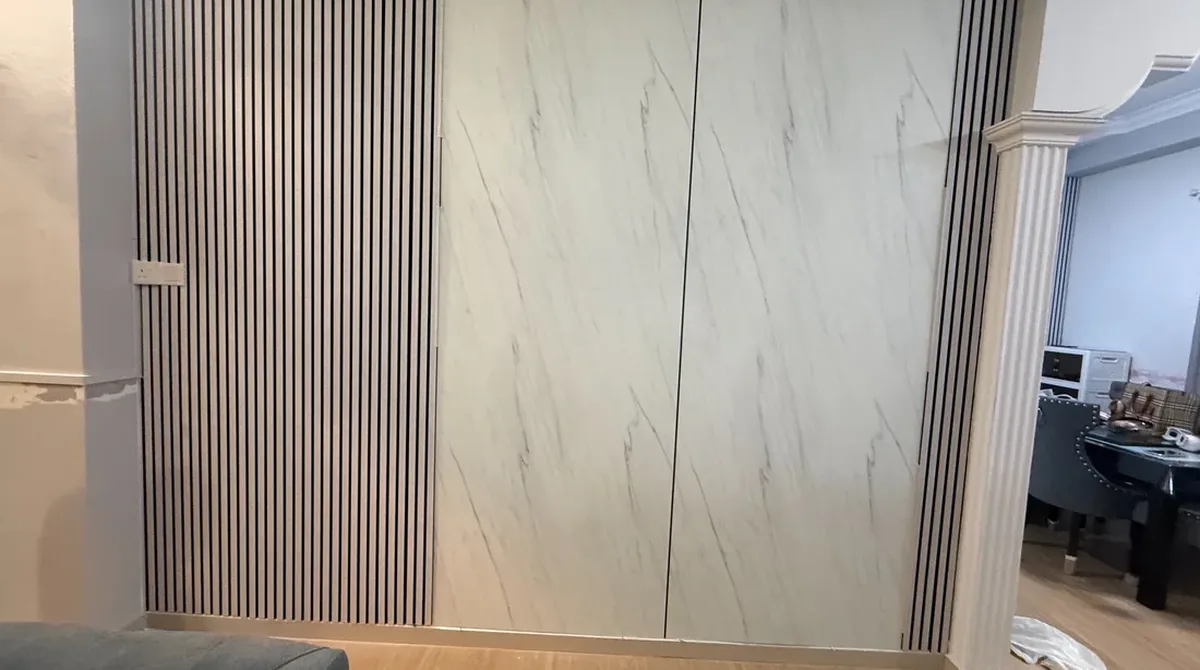
A PVC wall panel is a board of PVC composite fixed over an existing wall to give it a fluted, stone-look or wood-look face. In Singapore it is a better fit than MDF because there is no absorbent wood core to swell in our humidity. It suits TV walls, headboard walls and hallways. The wall behind must be sound and dry first, and in an HDB flat, screw fixings should stay within HDB's limits for wall panels.
What is a PVC wall panel?
It is a panel made of PVC composite, with no wood core. You will find it in two broad forms: ribbed fluted profiles, and flat sheets printed to look like marble, stone or timber. Both go over the wall you already have, so there is no hacking.
You will also see "carbon crystal board" and "bamboo charcoal board" on quotes and in showrooms. Both are high-density PVC composite sold under premium names, not separate materials. Compare the panels themselves, not the label.
Why does PVC suit Singapore humidity better than MDF?
MDF has an absorbent wood core. When moisture reaches a cut edge, the core takes it in and swells, and the face lifts. A Singapore flat gives moisture plenty of ways in: a wall shared with a bathroom, an air-conditioner drip, a wet mop against the skirting.
PVC composite has no absorbent core, so humid air and the odd splash do not get into it the same way. That is the reason we fit PVC composite panels and not MDF. Our fluted wall panel guide goes deeper into cores and profiles.
Fluted or flat: which profile suits the wall?
Fluted panels have ribs that throw thin lines of shadow. They add texture without colour, and they look best on one wall with plain walls around it. Flat stone-look and wood-look sheets read as one calm surface instead, closer to a slab than a pattern.
Many living rooms use both: a flat marble-look panel as the centre, with fluted strips on either side to frame it. Our feature wall design guide helps with choosing which wall to feature in the first place.
Where do PVC wall panels work best?
- The TV wall. The most common spot, because the wall is already the focus of the room. Plan the TV bracket and cable route before the panels go up. Our TV feature wall guide covers what tends to go wrong.
- The headboard wall. Seen up close from the bed, so a calm finish usually works better than a busy one. Plan sockets and reading lights first.
- Hallways. A narrow space viewed along its length, where vertical fluting draws the eye up and a flat panel keeps things quiet.
Where should you be careful with PVC wall panels?
- Behind a hob. Heat and grease make this a different job from a living room wall. We look at the exact spot at the site visit and tell you whether a panel suits it or tile is the better surface.
- Wet zones of a bathroom. Same answer: we advise at the site visit rather than promise in advance.
- Damp or flaky walls. A panel follows the wall behind it. Damp has to be traced and fixed first, and loose paint scraped back to a firm surface. Covering damp hides it; it does not cure it.
- Sun-facing walls. PVC moves a little with heat, so panels need a small expansion gap at the edges. The gap matters most on a wall that takes direct sun.
Which panel for this wall?
Pick the wall, the look you want and the state of the wall today.
What does HDB allow for wall panels?
HDB's renovation guidelines do not list PVC panels by name. The closest entry is this one:
- Solid timber and mirror wall panels. No permit, with fasteners no more than 6mm in diameter and 40mm deep. Plan screw-fixed panels to the same limits.
How your panels are fixed depends on the wall, and we confirm it at the site visit. Our HDB renovation permit guide lists the other wall and floor jobs and their conditions.
Panel, tile or paint?
A panel changes a wall without hacking, which is its main advantage over tile. Tile is still the usual choice for wet walls, and paint is the simplest way to change a colour. Our feature walls guide sets the three side by side.
How is a PVC wall panel job quoted?
Per project, after a free site visit. Our wall panel cost guide explains what moves the number. WhatsApp Kayler a photo of the wall at +65 8118 5520 and we usually reply the same day. Our own crew fits the panels, and the same team can lay your floor. The range is on our wall panel page.
Read next
- Fluted wall panels: profiles and cores
- TV feature wall guide
- Which wall to feature
- Our wall panel supply and installation
Common Questions
PVC composite panels handle humidity better than MDF because they have no absorbent wood core. MDF swells when moisture reaches a cut edge, and the face lifts. That is why we fit PVC composite rather than MDF. The wall behind still needs to be sound and dry, because a panel hides damp but does not cure it.
Carbon crystal board and bamboo charcoal board are trade names for high-density PVC composite, not separate materials. They are often sold at a premium because of the name. Compare the actual panels instead: the profile, the finish and how they will be fitted over your wall. Seeing a sample against your own wall and light helps more than the label does.
Yes. PVC composite panels are fitted over the wall you already have, so there is no hacking. The wall needs to be sound and reasonably flat first. Damp has to be traced and fixed, and flaky paint scraped back to a firm surface. Panels also need a small expansion gap at the edges, especially on a wall that takes direct sun.
HDB's guidelines do not name PVC panels. Solid timber and mirror wall panels need no permit, with fasteners no more than 6mm in diameter and 40mm deep, and screw-fixed panels should be planned to the same limits. Check your unit before fitting.
Be careful in both. Behind a hob, heat and grease make it a different job from a living room wall, and the wet zones of a bathroom are similar. We look at the exact spot at the free site visit and tell you whether a panel suits it or whether tile is the better surface there.
We quote PVC wall panels per project after a free site visit, rather than at a published rate. WhatsApp Kayler a photo of the wall at +65 8118 5520 and we usually reply the same day. Our wall panel cost guide explains what moves the number.
Planning a panelled wall?
Send Kayler a photo of the wall and its rough size. At the free site visit we check the wall is sound and dry, and bring samples so you can see the finish in your own light.
WhatsApp Kayler or call Kayler on +65 8118 5520